Powerless Leviathans: The Crisis of Authority in Western Europe
This piece is a collaboration between Ruben Cober (Essential Europe) and @posta_octavian from The Pan-European Journal.
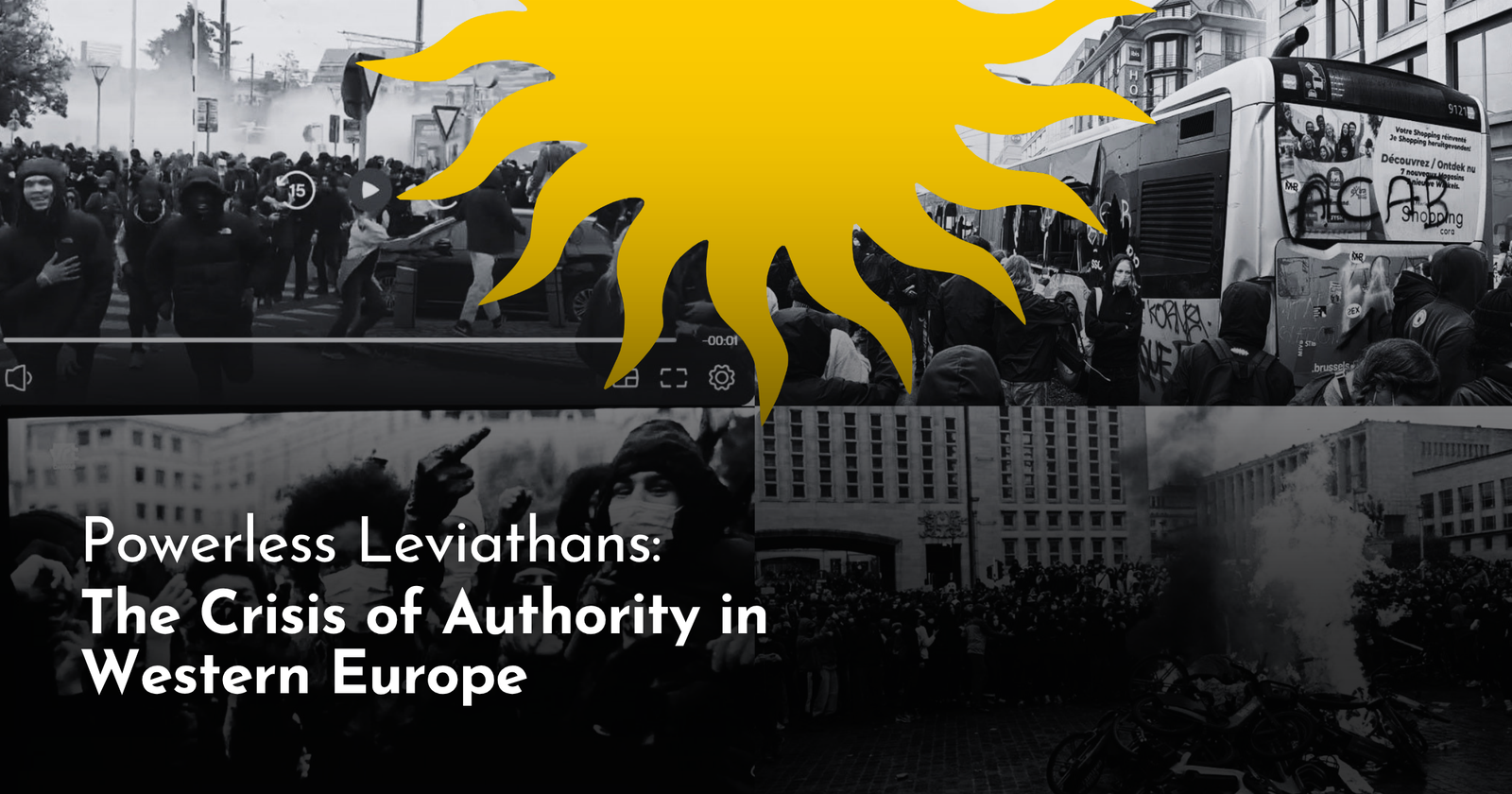
It is the 17th of October. Youths are rioting in France and are demanding better conditions in schools by burning down their own schools. Almost 500,000 “protesters” show up, far more than the 100,000 that the police expected. They easily overwhelm the police and engage in some of the worst looting Europe has seen this decade; videos of stolen Gucci bags and Playstation 5s are flooding social media. What is the state doing to stop this? Telling shopkeepers to hire private security because they cannot guarantee the right to property.
A spectre is haunting Europe - the spectre of state incapacity. In not a single Western European country does a week pass without a news story that exposes the weakness of state authorities. Such stories no longer shock regular news readers. Instead, there is widespread apathy among Europeans about yet another violent offence, another breach of Europe’s borders or blatant disrespect of our values and norms. Each time they are undermined, they become less normative.
The social contract, at least as it is commonly understood, is the idea that individual citizens grant the state authority over their lives in return for either security or prosperity. In modern Europe, especially with our high taxes, we might consider public services and welfare likewise part of the social contract.
This breakdown of the social contract is dangerous for multiple reasons. A state only has authority when it is recognised as an authority. If the state is then unable to keep up its part of the bargain — public services, security, infrastructure — then its people will refuse to grant that state recognition. However, the less people believe in the state, the less effective it becomes, which again worsens public services, security and infrastructure. A downward spiral can occur until authority effectively ceases to exist. Europe is not in danger of becoming Somalia, but as loss of authority begets further loss of authority, until the tide is turned, things will keep getting worse.
Illegal migration undermines the social contract
Authorities themselves first of all contribute to the erosion of their authority through their actions, inactions and reactions. In no policy area has this been more visible for over a decade than migration. Most European states have for years been unable to perform one of their most basic functions: deciding who enters the territory and who can stay or has to leave.
The border storming of Ceuta, the “small boats” and “mega-dinghies” that bring tens of thousands of people who have already crossed multiple European borders illegally from France to the United Kingdom, and the homeless illegals that roam Europe’s streets, are just the most visible examples. More telling are the statistics. The 4,284,637 “irregular” (the euphemistic word for illegal) border crossings that the EU’s Border and Coast Agency Frontex recorded between 2015 and 2025, represent 4,284,637 cases in which state authority has been undermined. And these were only the instances that were recorded.
Not European states, but human smugglers and traffickers have decided who crosses European borders for the past decade, protected by EU asylum treaties. As if these millions of illegal acts weren’t enough, European states are also failing to return those who they have ordered to leave their territory. In recent years, fewer than 25 per cent of the people who were given a return order in EU countries actually left.
France and Spain have the lowest return rates. Over the last five years, France had a return rate of less than 10 per cent. In 2023, it ordered 136,685 people to leave the country. Only 10,620 actually returned. In recent years France was only outdone by Spain, with a return rate of 5% to 12%. In 2023, 5,995 people left Spain out of 64,260 who were ordered to leave. As long as countries such as Syria, Somalia and Afghanistan do not cooperate in taking back their citizens, they effectively have more control than European governments themselves over return policy.
There is a sense of helplessness in the face of this massive influx of immigrants. European governments have given up effective control over migration and prefer to engage in propaganda campaigns and moral invectives against those who “notice” the problem over taking real action, whether out of conviction, fear of NGOs, ‘critical’ journalists or plain cowardice. This failure to respond has further undermined European states’ authority.
As a result of this failing authority, at least 1.3 million people are currently staying in the EU without valid residence status. And that is a conservative estimate. At the end of 2024, more than 220,000 people who had been ordered to leave Germany were found to still be living there illegally. And that is only a small part of the total number of illegal migrants.
In 2025, Germany deported just 23,000 of them. Nearly 180,000 were given a ‘toleration permit’, yet another instance of authorities undermining their own authority. At the end of 2024, there were 72,500 people in Germany who should have left at least six years (!) earlier. And in October 2025, according to BILD, there were 934,553 foreigners in Germany whose asylum applications had been rejected.
Who enters Germany, who remains in Germany, and who should have left long ago: the German state often doesn’t even know. A state that knows that tens of thousands of people live within its borders, including thousands who pose a security risk, yet cannot monitor or deport them, undermines its own authority even further.
To make matters worse, foreign nationals who should have left Germany years ago are often involved in attacks against its citizens. Germany and Western Europe have a problem with migrant violence, especially from Islamic countries. In Germany, Syrians are overrepresented in violent crime by 800% compared with the average German. Afghans are overrepresented by almost 900%.
State authorities have a monopoly on legitimate force precisely because citizens expect authorities to protect them. This is an essential property that makes a state sovereign, meaning ‘having the highest power’. But when more and more citizens feel less safe despite or even because of the state’s actions or inaction on illegal migration and failing to refuse those who have been ordered to leave, it damages that contract and therefore the state’s overall authority. A feeling of indignation against the state emerges.
Authorities also undermine their authority when, rather than setting boundaries and enforcing laws, they clear the way for intolerant actors who keep taking up more space.
The examples are countless. Radical Islamists, often funded by states like Qatar and Saudi Arabia have preached their messages that defy European values in European mosques. Or think of pro-Palestine demonstrators who occupied universities for months and damaged buildings across European campuses. Yet university boards and even education ministers treated them as legitimate interlocutors, even though they were masked and the boards didn’t even know who they were speaking with. In doing so, they are contributing to the erosion of state authority.
European states fail to deliver basic services
Providing infrastructure is another basic function of the state and part of the social contract with its citizens. Citizens accept taxation, regulation and the authority of government in return for essential public goods that individuals cannot efficiently provide for themselves. Reliable roads, railways, energy networks and other infrastructure are among the most fundamental of these goods.
Western European governments are increasingly failing in this basic function as well.
Germany’s Berlin Brandenburg Airport was originally scheduled to open in 2011, but opened only in 2020, after years of construction, planning and oversight problems. One of those problems was that they hired a fake engineer (!) who wrongly designed the fire protection system, which then had to be redone from scratch. Its estimated cost rose from around €2 billion to roughly €6.5 billion.
Stuttgart 21, Germany’s vast railway infrastructure project, offers an even more dramatic fiasco. The new Stuttgart central station was originally expected to open in 2019. It is now scheduled for 2031, with parts of the wider project extending into 2033. Its projected cost has risen from roughly €2.5 billion to around €14.5 billion. Deutsche Bahn has identified weaknesses in planning, project management and risk management, with the project ultimately backed by the German federal government and the city of Stuttgart.
France’s Grand Paris Express illustrates a similar problem of escalating costs and repeated delays. The project’s 2013 cost estimate of €20-22 billion has increased to over €36 billion as several sections have repeatedly been pushed back. Line 15 South was initially expected as early as 2018. It is now scheduled to open late this year. Tellingly, the project is being delivered by the Société du Grand Paris, a public body created by the French state for this sole purpose.
The failure is visible not only in large scale construction projects, but also in the infrastructure people depend on every day. The Dutch’ electricity grid, for example, is increasingly suffering from grid congestion. In many parts of the country, the grid is already unable to accommodate new electricity connections, putting businesses on waiting lists and slowing housing construction, economic growth and the energy transition that the state itself mandated.
In general, public services are deteriorating in many European countries. A 2026 survey has shown that 81% of the French think the justice system is broken, 73% the education system is broken and 60% that the healthcare system is broken. With such horrific numbers, it is almost inevitable that more and more youths radicalise and lose respect for the state.
These examples point to a broader problem than construction failures. Infrastructure and healthcare are one of the most basic functions of government: citizens expect the state to use its resources and institutions to provide and maintain the systems on which everyday economic and social life depends.
Yet across Western Europe, governments increasingly struggle to deliver one of the basic functions for which citizens grant the state authority in the first place. The visibly growing gap between what governments are expected to provide and what they are actually able to deliver further undermines confidence in the competence and legitimacy of the state. A state that fails to build or provide undermines its authority.
It is also here that the downward spiral expresses itself very acutely. Many of these infrastructure projects rely on the population making compromises. For instance, an airport will be loud, a new highway may displace some people, and a nuclear power plant has a very low chance of failing. In order for the state to effectively build infrastructure, it requires a population to submit to its authority and understand that even if they make personal sacrifices, as the infrastructure will presumably benefit society, it will ultimately benefit them too.
As people are losing faith in the state, the willingness to compromise with authority is fading, which in turn makes building infrastructure even more difficult. An X post about a local Green party grouping stopping a Lidl from being built in their home town recently went viral, with over 5.9 million views. People were outraged that members of the “boomer” generation were preventing the construction of a large supermarket which would not only have been convenient and provided cheaper goods, but also could have provided jobs to young people. Instead they claimed they wanted to protect “small businesses”, likely small shops run by members of said generation. The lack of consciousness of the collective interest is what drives such behaviour and erodes state capacity.
The paradox of the 21st-century state: losing grip and gaining control
Paradoxically, even as state capacity and authority declines, too many Europeans automatically look to the state for solutions to almost every problem, while at the same time becoming more sceptical of it. Most of all, they eagerly await another ban — the highest goal for the politically illiterate — and bans are the only thing European governments are still good at doing.
This brings us to the paradox of twenty-first century Western European states: while they are losing grip on those who actually undermine the authority of the state and the security of citizens, governments wield more and more power over law-abiding citizens in ever more areas of life. Instead of protecting citizens from criminals who exploit state weakness, governments increasingly believe they should protect individuals from themselves. It is precisely law-abiding citizens who are easiest to push around, so state authority focuses on them.
This applies in particular to freedom of expression and information. Behind policy proposals to restrict this right lies a deeply pessimistic view of humanity. It seems that the liberals of today have given up on their own principles: while the Enlightenment and the classical liberalism it spawned dreamt of educated and self-determined citizens who would make rational decisions in their own interest, today’s liberalism seems to exclusively take a defensive position. Citizens must instead be protected from “illiberal” thoughts, kept away from the wrong people or perhaps even need to be protected from themselves.
For modern liberalism, “our democracy” is under constant threat: from social media, algorithms, Trump, the far right or fake news. There are thousands of liberals who genuinely believe that Ukraine destroying a Yandex data centre influenced the voting behaviour of millions of people. Ironically, this defensive posture against outside criticism makes today’s liberals the group that believes least in the individual’s ability to make their own choices. Democracy is only as strong as its weakest link. And according to politicians ranging from social democrats to so-called liberals, citizens themselves are that weakest link.
Based on this delusion, Chancellor Friedrich Merz called for far-reaching regulation of social media and an end to anonymity online, shortly after the AfD’s election victory in Saxony-Anhalt, in order to protect citizens from “disinformation, personal attacks and discrimination”. “And please don’t come at me with that nonsense about ‘freedom of speech’,” Merz said. There is nothing more dangerous to freedom than incompetent and unpopular politicians.
As CDU parliamentary leader, that same Merz filed more than one hundred criminal complaints against Germans over insults directed at him, including relatively mild ones such as “Arschloch” and “Pinocchio”. The Federal Chancellery has also been in contact with prosecutors in dozens of cases concerning potentially criminal insults against Merz.
The British justice system, too, is busy suppressing the wrong opinions. According to the Free Speech Union, 62,000 Britons have been arrested and 12,292 convicted over the past five years for the Orwellian term “speech offences”, including social media posts and memes. The government now also wants to restrict the use of VPNs that hide IP addresses. In doing so, it would place itself alongside countries such as North Korea, China, and Iraq.
Moreover, the definition of Islamophobia has been stretched so far that blasphemy laws are effectively making a comeback. The Labour government also wants to restrict VPNs (software that conceals IP addresses). This would place the United Kingdom in the company of countries such as North Korea, China and Iraq. And all this in the land of the Magna Carta and the Bill of Rights, documents that sought to limit the power of the state.
In September, Prime Minister Burnham announced a “National Centre for Information Defence” that is intended to make citizens “more resilient” and protect them against (Russian) disinformation. “There is no national security without a strong and cohesive society,” Burnham stated. I have a suspicion as to what Britons might actually see as the greatest threat to that strong and cohesive society…
The European Commission, meanwhile, sees Big Tech platforms as the great threat to children. The EU KIDS Act is intended to limit children’s use of social media and address its harmful effects. A legitimate objective, but “think of the children” is an argument that has frequently been abused to justify legislation that ultimately restricts freedom more than it provides safety. The fact that social media can have a negative influence on teenagers does not justify requiring all Europeans to verify their age online, or abolishing the right to anonymity online.
Another vivid example is the European Commission’s original plan to combat child sexual abuse online, also known as ‘Chat Control’. The law proposes scanning virtually all citizens’ communications on platforms such as WhatsApp and Facebook. Real perpetrators would hardly be touched because they mostly share images on the dark web and in closed groups. Yet privacy and the right to confidential communication for all citizens were deemed subordinate. One of the champions of Chat Control? French president Emmanuel Macron, whose party sits in the “liberal” ALDE group in the European Parliament.
Similarly, the EU’s AI Act allows the use of face-recognition cameras by authorities in “certain cases.” Let’s see how limited that use proves to be. Highway cameras in many European countries are already used for purposes far beyond their original intent.
Do not misinterpret the attempts by European states to ban and prohibit as “strength”. It is a sign of weakness. The less they are able to act on the ground, the more they retreat into legalism. To a hammer, everything is a nail. For a modern liberal, who must govern a state that is more and more incapable of action, everything must be propaganda and wrongthink. The escape into prohibitions and free speech restrictions is a desperate attempt by liberal democracies to maintain the illusion of normalcy amid an unprecedented loss of legitimacy and authority, targeting those who speak up about the chaos rather than trying to fix it.
Europe can do without legislation that restricts freedom more than it enhances security. A state with genuine authority does not need to harass individual citizens. The philosopher Hegel himself understood this: the stronger the state and the more secure its civil society, the more lenient its punishments. As the authority of European states is deteriorating, we can apply this to free speech: a secure civil society with genuine authority has no need to restrict free speech.
After all, freedom is the highest political good, and should only be restricted in a genuine emergency, not because of wrongthink here and there. “Those who would give up essential liberty to purchase a little temporary safety, deserve neither liberty nor safety,” Benjamin Franklin wrote in 1755. Who still defends that principle in Europe in 2026? And who protects European citizens when the state itself undermines their rights, freedom and security?
Rather than serving citizens and protecting them, Western European governments increasingly appear to compensate for state incapability through restrictions on individual freedom. If the establishment does not turn things around, “different”, less savoury political forces will restore order in their stead.

Octavian
Main WriterAve Europa Germany

Ruben Cober
CollaborationEssential Europe