How the French Right's Position on Europe is Changing: Observations from a Pan-European Inside RN
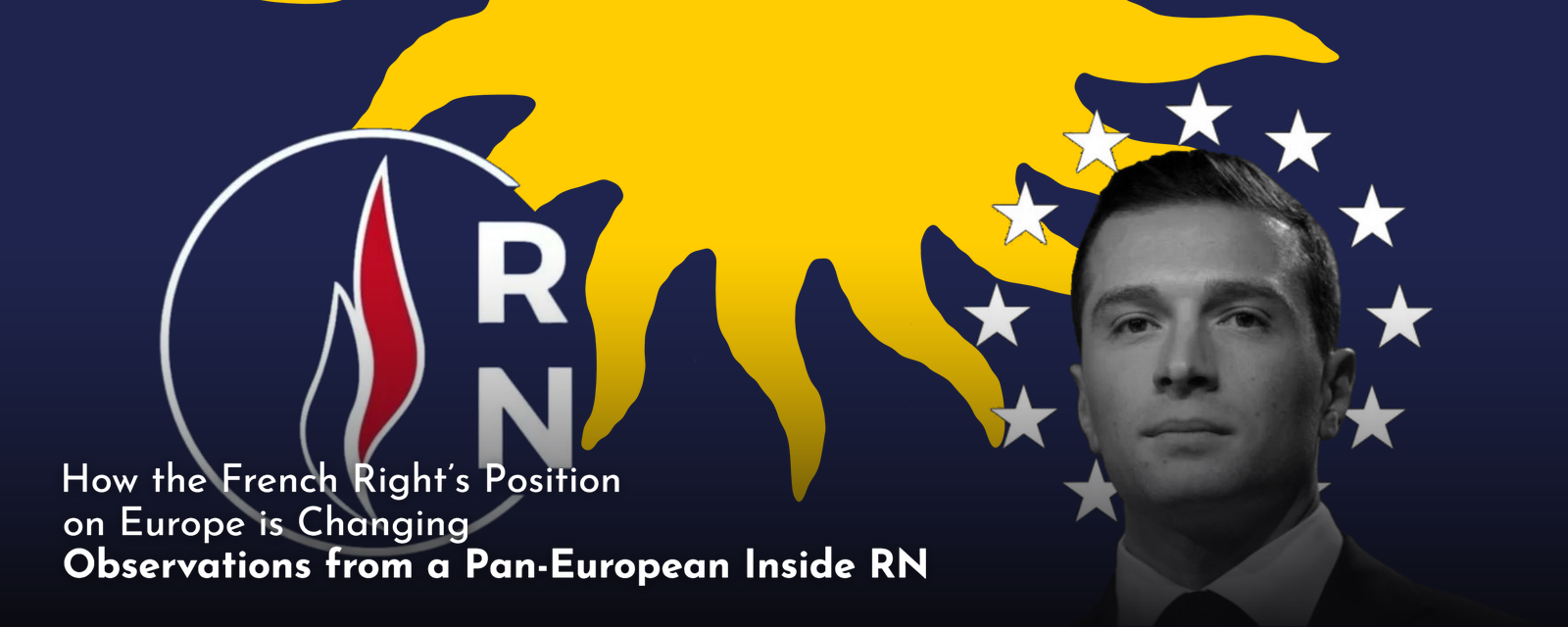
This piece was written by a friend of the Pan European Journal. Said person is a long-time member of Jordan Bardella's Rassemblement National (National Rally in English).
Jordan Bardella will never fully satisfy the historical sovereigntist wing of his political camp, even if he presents himself as part of that tradition. His current positioning reflects a significant evolution away from classical French sovereigntism and toward a more pragmatic conception of European power.
His definition of Europe as a form of "co-ownership" is intellectually sound. Likewise, he is right to challenge the growing influence of the European Commission while simultaneously projecting himself as a future member of the European Council, where national leaders ultimately exercise political authority. This combination of institutional criticism and strategic engagement is coherent.
More broadly, Bardella articulates an interesting vision that, in several respects, falls within the continuity of Emmanuel Macron's doctrine of European strategic autonomy. One of his strongest ideas is that France should provide security guarantees to Eastern European nations—particularly Poland and the Baltic states. This reflects a significant shift in French strategic thinking.
Historically, France's European strategy was largely structured around reassuring Germany and Northern European countries regarding fiscal discipline and budgetary credibility. The emergence of the military and security dimension has altered this equation. Bardella appears to understand that France can now build stronger partnerships with Eastern Europe, exchanging leadership on defense and security for political support on more conservative and sovereign matters, rather than remaining trapped between Northern demands for fiscal orthodoxy and Western European humanitarian politics.
This constitutes one of the main differences with Macron: while sharing similar objectives regarding European power and strategic autonomy, Bardella adopts a more confrontational approach toward the Commission and places greater emphasis on the balance of power between member states and Brussels.
His position toward Poland is particularly strong. He projects himself effectively as a future European Council leader and understands the strategic importance of Franco-Polish cooperation. His willingness to work closely with the European Conservatives and Reformists (ECR) group is also a positive development.
On the European Union itself, his implicit doctrine could be summarized as "change everything without destroying anything." Rather than advocating withdrawal or institutional rupture, he seeks to redirect the Union toward different priorities while preserving its framework.
Regarding NATO and Russia, Bardella's position is notably stronger than Marine Le Pen's. He correctly identifies the consequences of a potential American disengagement from Europe and the resulting need for France to assume greater responsibility in supporting European rearmament. His refusal to advocate withdrawal from NATO's integrated military command while the war against Russia continues demonstrates strategic realism. More generally, he shows greater lucidity regarding the Russian threat than previous generations of the French nationalist right.
His support for extending the French nuclear umbrella to European partners is particularly significant. This is one of the most important developments in contemporary French strategic thinking and represents a credible response to growing security concerns in Eastern Europe.
He is also right to advocate a strong European preference in defense procurement. European rearmament should strengthen Europe's industrial base and strategic independence rather than deepen external dependencies.
His position on Russia is generally sound: support for a ceasefire accompanied by meaningful security guarantees, combined with the maintenance of France's commitments in Eastern Europe. He appears to understand the central role that Eastern Europe now plays in France's geopolitical projection. This reflects a doctrine that values the Baltic states and Poland not merely as peripheral actors but as essential partners in the construction of a European balance of power.
He is equally correct in highlighting the Commission's weaknesses in trade negotiations and commercial agreements. On the next Multiannual Financial Framework (MFF), he will likely be able to secure meaningful concessions against the Commission by leveraging intergovernmental coalitions.
The key concepts underpinning Bardella's vision are strategic autonomy, rearmament, power, prosperity, independence, and the emergence of a new French leadership within Europe. His political message is increasingly that of a "French sovereigntist" seeking to build a "Europe of power" rather than dismantle the European project itself.
Overall, this represents a clear improvement over Marine Le Pen's traditional positions. While it may be difficult for historical sovereigntists to fully embrace this evolution, it should nevertheless be regarded as a positive and intellectually coherent development.
Simon
Guest WriterAve Europa France