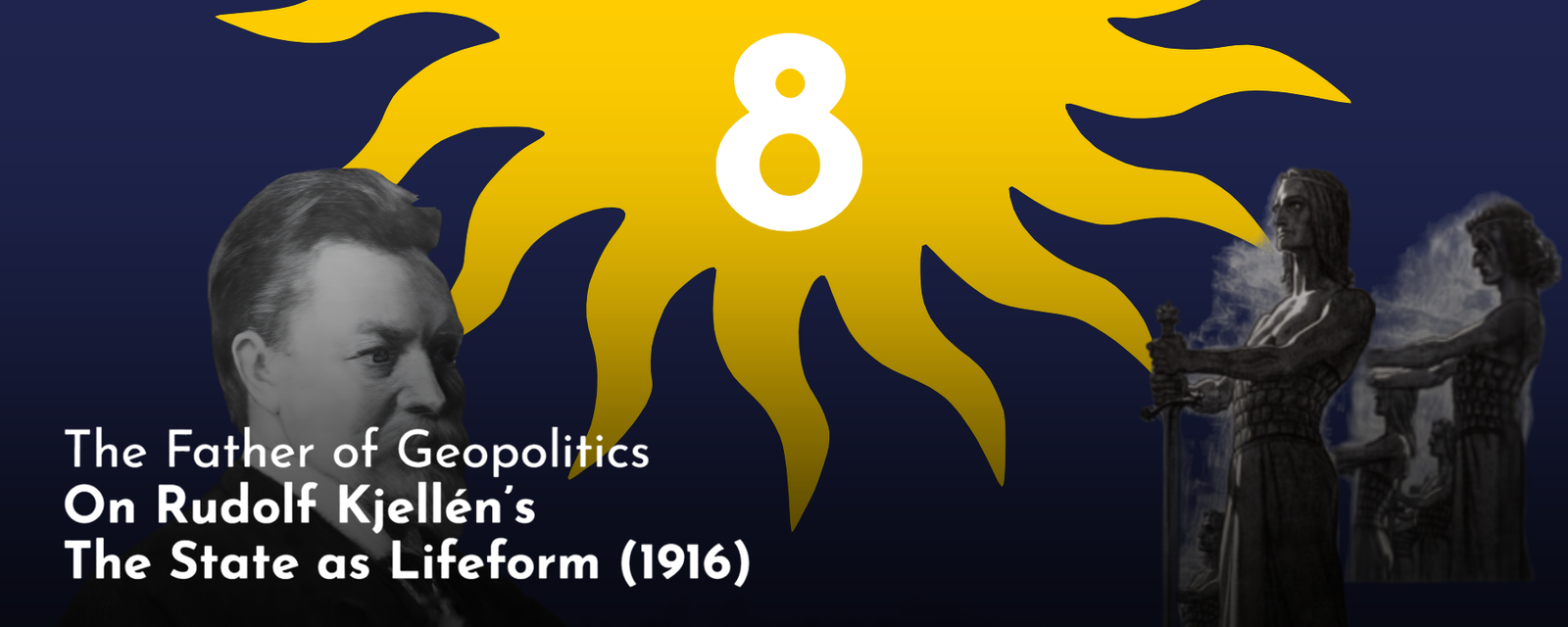
The Father of Geopolitics: On Rudolf Kjellén's The State as Lifeform (1916)
I. Political Science and the Organic Conception of the State
The State as Lifeform opens with a discussion of science itself, though one considerably more sophisticated than the reflections found in Stormakterna (1905). Kjellén begins by attacking what he regards as the dominant conception of the state in modern political thought: the view that the state is, in principle, nothing more than a legal subject. According to this conception, the state is reducible to its constitution and legal order. Political knowledge consequently becomes legal knowledge, leaving political science without an independent object of inquiry. If the state is merely a juridical entity, constitutional law has already exhausted its study.
Attempts to escape this reduction, Kjellén argues, have proved equally unsatisfactory. Humanistic political science sought to ground the study of the state in history, philosophy, or metaphysics, thereby subordinating political science to neighbouring disciplines. The result was simply a different form of dependency. Political science remained without a subject matter properly its own.
While science ought to stand above the intellectual fashions of any particular age, the legal conception of the state is itself a distinctly historical phenomenon. The relationship between state and individual has fluctuated throughout history, producing successive conceptions of political order. In classical antiquity, the state possessed overwhelming authority; during the Middle Ages, power became fragmented among corporate bodies; absolutism restored political centralisation; and finally, the nineteenth century saw the triumph of individualism and liberal constitutionalism. The liberal Rechtsstaat therefore represents not an eternal scientific truth, but one historical configuration among others. If political science is to discover the essence of the state, it must seek it elsewhere.
The state first presents itself to the individual as a coercive power, limiting the sphere of personal freedom. Yet it simultaneously appears as protector, shielding individuals from the encroachments of others. In both respects the state ultimately acts not on behalf of particular persons but in defence of a legal order standing above them. In this sense the state manifests itself as a will to power. It possesses purposes of its own and the institutional organs necessary to realise them. Its power exists to preserve public order, maintain social peace, and secure the continuity of the political whole.
Yet the modern state does considerably more than preserve legal order. It provides assistance to those in need, finances education, builds infrastructure, and increasingly concerns itself with the social and cultural conditions under which its citizens live. The state's horizon therefore extends beyond the merely legal. Cultural life, economic organisation, and social welfare all fall within its sphere of action, despite lying beyond the formal limits of law.
Political science must therefore account for the state as a social, economic, and cultural reality no less than as a legal one. State and society cannot be treated as separate entities, for society constitutes an element within the state itself. Once the legal abstraction is filled with actual economic and social life, the state becomes both more concrete and more complex. It no longer operates solely according to juridical principles but according to the broader laws governing living organisms.
This social conception rescues political science from becoming a mere branch of jurisprudence. Yet it immediately raises another difficulty. If the state is fundamentally social, what distinguishes political science from sociology? Does the concept of the state ultimately dissolve into that of society?
Kjellén rejects this conclusion. The modern state, he argues, resembles Janus: it has two faces, one turned inward toward society and another outward toward the international realm. To think of a state is necessarily to think of a bounded territorial entity, and the concept of the state is therefore inseparable from geography. Yet territory alone is insufficient. The geographical realm acquires political significance only through the people who inhabit it. State, people, and land thus constitute an inseparable unity.
These elemental components, however, do not exhaust the nature of the state. A people settled upon a territory inevitably develops forms of social organisation, economic life, and culture. Through this development the state becomes more than the sum of its constituent elements: it becomes a living historical personality. Geography alone cannot explain this spiritual dimension, yet neither can history or philosophy in isolation. Political science must therefore unite both perspectives, studying the state simultaneously as a natural organism and a moral organisation – not merely as a legal abstraction supplemented by economic or social considerations, but as the living totality in which all these dimensions converge.
II. The State as Realm: Geopolitics
Having established that political science must study the state as a living organism rather than merely as a legal abstraction, Kjellén turns to the first of the state's constituent aspects: geopolitics. He defines the discipline in the following terms:
"Geopolitics is the study of the state as a geographical organism, or as a phenomenon in space: that is to say, the state as land, territory, domain, or, most aptly, realm. As a political science, [geopolitics] keeps its attention steadily fixed upon the state as a unit and seeks to contribute to an understanding of the nature of the state; whereas political geography studies the Earth as the dwelling place of human societies, in relation to the Earth's other characteristics."
This definition immediately distinguishes geopolitics from political geography. Whereas political geography begins with the Earth and examines the spatial distribution of political communities, geopolitics begins with the state itself. Territory is therefore not treated simply as physical space, but as one of the constitutive elements of a political organism.
Kjellén nevertheless observes that, in historical terms, the ethnic element is prior to the territorial one. The idea that a state necessarily presupposes a clearly delimited territory is, he argues, a specifically modern conception. The modern state is inseparable from its domain – its cities, countryside, and natural resources – for every state is, in a literal sense, a landowner. Yet unlike private landowners, the state cannot dispose of its property at will. It cannot abandon one territory in favour of another, nor can it detach itself from the soil upon which its historical existence has developed. The state is rooted in its land, and in the people whose historical life has become bound to that land. Severed from either, it ceases to exist as the political organism that it once was.
For this reason, the state cannot be understood as an abstract legal construction. Like every living organism, it depends upon material conditions for its existence. Its territory is not merely the setting within which political life unfolds; it is an indispensable component of the state itself. This organic relationship between state and territory becomes especially apparent in war, which Kjellén describes as the ultimate testing ground of geopolitical thought:
"Never does the organic nature of states appear more clearly than in war. War is, as it were, an experimental field for geopolitics, just as it is for all politics, and general staffs ought to be academies of science, not least in this branch of political science. For it falls to them to draw up campaign plans with due regard to the greater or lesser value of the enemy's territories within the political organisation of the hostile state; they must therefore study them precisely from this point of view. The object of modern warfare is to break the opponent's will; the most radical means of doing so is to seize the whole realm, for that is equivalent to depriving him of control over his own body. Thus France itself became the prisoner in 1871, and could not free itself from Germany's embrace until it had yielded to the force of Germany's will."
War reveals most clearly that territory is not an external possession but a part of the state's own body. To occupy the realm is therefore not merely to conquer land, but to incapacitate the political organism itself. Military strategy accordingly requires an understanding of territory not only in geographical terms, but also in relation to the political and economic functions performed by its various regions.
Kjellén consequently conceives of the geographical state as an organic whole, whose individual regions perform functions analogous to those of the organs of a living body. Each region possesses its own landscape, natural resources, population, and productive capacities. These local differences are not obstacles to political unity, but rather the conditions upon which it rests. The individuality of the state lies precisely in its ability to coordinate these diverse elements into a coherent whole, developing and directing their respective capacities in accordance with the needs of the organism itself. Just as the muscles of the body become stronger through exercise, so too does the state cultivate and enhance the inherent possibilities contained within its territory.
The strength of the political organism is therefore inseparable from the quality, extent, and organisation of its territory. Throughout history, the state's will to power and will to growth have generated an ever-increasing demand for space. Political development has repeatedly taken the form of territorial expansion, reflecting not merely ambition but the organic requirements of increasingly complex societies. As Kjellén observes:
"It is now evident that this enlarged scale constitutes a disturbing factor for the full sovereignty of the smaller states. Merely by virtue of its physical mass, the great state exerts a kind of gravitational pull upon the lesser ones. Deckert observed this within the American state system, where the United States functions as a political sun; and the same phenomenon is readily apparent in Russia's influence over Asia and over certain smaller Slavic peoples in Europe. Towards the other Western states, however, Russia's physical attraction is neutralised by a kind of spiritual repulsion, arising from its lower level of culture. Conversely, vast and uniform spaces themselves stimulate political expansion. Across the Russian steppes, the American prairies, and the seas of Britain, the gaze stretches towards infinity, awakening the conqueror's longing for further horizons; whereas the small nation, confined within narrow limits, readily sinks into a merely vegetative existence, like the petty bourgeois contemplating himself in the mirror of a provincial town. Here we perceive the tendency of great spaces to increase themselves politically, just as great accumulations of capital seek to expand."
Large territorial spaces thus generate political dynamics of their own. Great powers exert an attraction upon smaller political communities simply by virtue of their scale, while extensive and relatively open geographical environments encourage further expansion. Small states, by contrast, risk political stagnation precisely because their limited territorial horizons constrain their possibilities for development. Space is therefore not merely a passive condition of politics, but an active force shaping the historical trajectory of states.
But this should not be mistaken for geographical determinism. Kjellén repeatedly insists that territory is only one of the fundamental forms of the state, albeit an indispensable one. Nevertheless, it occupies a unique position among these elements. Land is the only truly permanent component of the political organism. Peoples change, generations pass away, institutions are reformed, and cultures evolve, but the geographical foundation remains. The people do not emerge from the land in any biological sense; rather, they grow into it, investing it over time with their labour, institutions, traditions, and historical memory. Upon this foundation arise society, commerce, industry, culture, and political life itself.
A people may disappear, whether through conquest, migration, or gradual assimilation, yet the territory endures. For Kjellén, the realm therefore constitutes the enduring substrate upon which the historical personality of the state is continually formed and reformed. It is the most permanent element of political existence and, as such, the indispensable point of departure for geopolitics.
III. The State as People: Ethnopolitics
Having examined the territorial dimension of the state, Kjellén turns to its second elemental form: the people. If geopolitics studies the state as realm, ethnopolitics studies it as a national community. The two are inseparable. Just as the state cannot exist without territory, it cannot exist without a people. Neither element can be reduced to the other, yet neither possesses political significance on their own.
Kjellén therefore rejects any conception of the state that treats the population as a mere aggregate of individuals. A people is not simply the sum of those presently living within a given territory, any more than a state is merely the legal authority exercised over them. Rather, it constitutes a historical continuity extending across generations. The society of the present is only the latest expression of a much older national existence, linking the living with their ancestors and with generations yet unborn.
This conception also clarifies the relationship between land and people. Whereas territory represents the relatively permanent and static element of the state, the people constitute its dynamic element. Populations move through space, expand and contract through birth and death, and continually renew themselves through successive generations. The state therefore unites permanence and movement within a single political organism. Its geographical foundation remains comparatively constant, while its human component is characterised by continual renewal.
The continuity of a people does not arise automatically through biological reproduction alone. Nor is the nation merely the accidental outcome of demographic processes. What binds successive generations together is a shared historical consciousness expressed politically through loyalty. Loyalty is therefore one of the principal forces of political life, providing the link through which a people recognises itself as the same historical community despite the continual replacement of individuals.
For Kjellén, one of the state's highest tasks is precisely the cultivation and preservation of this loyalty. The state must foster attachment not merely to existing institutions, but to the national community itself. Individuals should recognise themselves simultaneously as distinct persons and as members of a historical people. In this respect, the political organisation of the state performs a function that the nation, left to itself, cannot fully achieve.
The nation possesses an instinctive solidarity, but these natural bonds require political form if they are to achieve historical permanence. Through the state, the nation acquires a higher degree of organisation and self-consciousness. Its spontaneous impulses are disciplined through law, its collective strength is directed towards common purposes, and its historical existence assumes a definite political form. The state therefore does not create the nation ex nihilo, but neither does it merely administer a pre-existing social reality. It transforms a natural community into a political personality.
This relationship illustrates one of the central themes running throughout The State as Lifeform: Kjellén's persistent refusal to separate nature from culture. The nation is neither a purely biological phenomenon nor a purely cultural construction. Rather, it is an organic unity in which inherited characteristics, historical development, shared experience, and political institutions mutually shape one another. The biological and the spiritual are not opposing principles, but complementary aspects of the same living whole.
For this reason, ethnopolitics cannot be reduced to anthropology, ethnography, or demography. Although each contributes valuable knowledge, none studies the people from the standpoint of the state itself. Political science remains concerned with the nation insofar as it constitutes one of the elemental forms of the political organism. The object of ethnopolitics is therefore not humanity in general, nor necessarily particular ethnic groups considered in isolation, but the people as the bearer of statehood.
Kjellén consequently distinguishes carefully between the nation and society. Society belongs primarily to the sphere of the present. It encompasses the changing world of occupations, interests, classes, associations, and cultural movements that characterise any given generation. Society is fluid and constantly evolving. The nation, by contrast, possesses a much longer temporal horizon. It constitutes the continuity that persists beneath the changing forms of social life. Whereas society changes from generation to generation, the nation preserves the identity of the political organism through time.
This distinction explains why Kjellén consistently treats the nation as more fundamental than the social conflicts that arise within it. Economic interests, class divisions, and cultural disagreements undoubtedly shape political life, but they do not exhaust its meaning. They are transient manifestations of a deeper historical unity. The nation remains the enduring subject of political history, while society expresses the changing circumstances through which that history unfolds.
It follows that the vitality of the state ultimately depends upon the relationship between its two elemental forms. Territory provides the geographical foundation upon which political life becomes possible, while the people provide the historical continuity through which that territory acquires political meaning. Neither land without people nor people without land constitutes a state. Only their organic union gives rise to the historical personality that political science seeks to understand.
Ethnopolitics therefore complements geopolitics. Together they establish the two elemental conditions of political existence: the realm that endures and the people that lives within it. All the remaining dimensions of the state – its economy, society, constitutional order, and administration – presuppose this more fundamental union. The state is consequently neither merely a territory nor merely a population, but a living political personality whose geographical and human elements have become inseparably intertwined through history.
IV. The State as Oikos: Ecopolitics, Sociopolitics, and Government
Having examined the state in its elemental forms as territory and people, Kjellén turns to those aspects of political life that arise from their interaction. If geopolitics and ethnopolitics establish the material foundations of the state, ecopolitics, sociopolitics, and the science of government examine the higher forms of organisation through which the political organism sustains and directs itself. These dimensions do not exist independently of the realm and the people; rather, they express the increasingly complex forms of life that emerge once a people has become historically rooted in a particular territory.
Kjellén begins with the economy. In its economic aspect, the state is properly understood as an oikos – a household. Political economy, viewed from the standpoint of political science, is therefore not principally concerned with markets or abstract theories of exchange, but with the material foundations of the state's existence. The central question is how a political community organises production, distribution, and consumption in order to sustain itself over time.
This perspective distinguishes Kjellén's ecopolitics from classical liberal economics. The latter generally treats economic life as an autonomous sphere governed primarily by the interactions of individuals. Kjellén, by contrast, regards the economy as one of the organs through which the state maintains itself. Economic activity cannot be separated from political existence, because the productive capacities of a people ultimately determine the strength, independence, and resilience of the political organism.
For this reason, relations of production and capital acquire geopolitical significance. Trade, investment, and finance do not merely connect private individuals; they bind states together through relationships of dependence and influence. Creditor and debtor states occupy fundamentally different positions within the international order, and economic relations become inseparable from political power. Commerce therefore belongs not only to economics, but also to political science.
This understanding leads Kjellén to one of the central concepts of his economic thought: autarky. By autarky, he does not mean complete economic isolation, nor does he suggest that any modern state could become wholly independent of international trade. Rather, autarky functions as a regulative ideal. The healthy political organism should possess sufficient productive capacity to sustain itself under exceptional circumstances, particularly during war. Economic dependence may be unavoidable, but excessive dependence threatens the freedom of political action.
Autarky thus expresses the economic individuality of the state. Just as geopolitics seeks the geographical individuality of the realm and ethnopolitics the historical individuality of the nation, ecopolitics seeks the material individuality of the political organism. The more fully a state can meet its essential needs through its own productive capacities, the more securely it preserves its political independence.
This ideal should not be understood merely in quantitative terms. Kjellén's concern is less with economic self-sufficiency as such than with the harmonious organisation of the national economy. Agriculture, industry, commerce, and finance must develop in a balanced relationship, each complementing the others within the larger unity of the state. A healthy economy resembles a healthy organism: its various functions are differentiated yet mutually dependent, and each contributes to the vitality of the whole.
The transition from ecopolitics to sociopolitics follows naturally from this conception. Every economic order gives rise to a corresponding social order. The household of the state is not a homogeneous body, but a complex association of occupations, professions, classes, and organised interests. Modern society therefore contains an inherent plurality that continually generates tensions and competition.
Kjellén does not regard these conflicts as abnormal or pathological. On the contrary, they are inevitable consequences of economic development and increasing social differentiation. Industrialisation, urbanisation, and the division of labour produce a multiplicity of interests that cannot simply be abolished through political decree. Social conflict is therefore a permanent feature of modern political life.
Society is dynamic, fragmented, and often conflictual; the nation, by contrast, is comparatively stable, integrating successive generations into a common historical community. Economic and social divisions may transform the character of society, but they do not necessarily dissolve the national personality upon which the state ultimately rests.
From this perspective, one of the principal functions of the modern state is the mediation of social conflict. Because the various interests that compose society inevitably compete with one another, they require a political authority capable of representing the interests of the whole rather than those of any particular class or profession. The state must therefore regulate economic and social life without becoming merely the instrument of particular interests. It exists neither to suppress society nor to surrender itself to its internal divisions, but to preserve the unity of the political organism within which social plurality can continue to exist.
Thus government represents the active will of the state – the institutional expression of its capacity to act purposefully in pursuit of its own preservation and development. Constitutional arrangements undoubtedly matter, but they do not exhaust the reality of government. The legal structure of the state provides only the formal framework within which political life unfolds. The more fundamental question concerns the manner in which political authority is actually exercised.
Accordingly, Kjellén places particular importance on administration. If legislation defines the legal form of the state, administration expresses its living activity. Through administration, the state coordinates its various functions, reconciles competing interests, and pursues the common good of the political whole. Here legal science and political science intersect, but do so from different perspectives. Jurisprudence examines the formal competence of governmental institutions; political science seeks to understand how those institutions actually sustain the life of the state.
These reflections also shape Kjellén's understanding of democracy. He acknowledges that representative institutions reflect the dominant political tendencies of the nineteenth century and have become integral to the constitutional development of modern Europe. Democracy, in this sense, expresses an important stage in the historical evolution of the state.
Nevertheless, Kjellén rejects the idea that democracy constitutes the final form of political organisation. Like every other constitutional arrangement, it must ultimately be judged according to the requirements of the political organism rather than according to abstract political principles. If democratic institutions cease to preserve the unity and vitality of the state, they cannot claim unconditional authority merely by virtue of their democratic character.
For this reason, Kjellén anticipates the emergence of new constitutional syntheses capable of reconciling popular participation with effective political leadership. The precise institutional form is less important than the underlying principle: every political organism requires a directing centre capable of maintaining coherence among its various parts. Government cannot simply mirror the diversity of society; it must organise that diversity into a unified political will.
This conclusion follows from Kjellén's broader conception of political life. The state is not a constitution, nor is it reducible to the legal procedures through which governmental authority is organised. Constitutions may change, administrative forms may evolve, and representative institutions may expand or contract, yet the political organism persists beneath these external forms. Law serves life, not the other way around. The vitality of the state therefore cannot be measured solely by the perceived elegance of its constitutional arrangements, but by the extent to which those arrangements enable the political personality of the state to preserve itself, coordinate its internal life, and respond to the changing conditions of history.
Ecopolitics, sociopolitics, and the science of government thus complete Kjellén's conception of the state as a living organism. Territory provides its body, the people its historical continuity, the economy its material sustenance, society its differentiated internal life, and government the conscious will through which these diverse elements are brought into a coherent political whole. Only by considering all of these dimensions together can political science grasp the state as it exists in reality: not as a legal abstraction, but as a living personality subject to the law of life.
V. The State and Human Will Under the Law of Life
Having examined the constituent aspects of the state, Kjellén concludes The State as Lifeform by considering the laws governing the existence of political organisms as such. If the state is genuinely a living personality rather than a legal abstraction, it must necessarily be subject to the same fundamental conditions that govern all forms of life. States come into being, develop, mature, and ultimately perish. Political science must therefore concern itself not merely with the structure of the state, but with its life cycle.
This naturally follows from Kjellén's organic conception of politics. The state is not created simply through constitutional enactment, nor does it cease to exist merely because a legal order has been replaced. Its existence is historical rather than purely juridical. Like every living organism, the state possesses a biography: an origin, a period of growth, moments of strength and weakness, and eventually an end.
History itself provides abundant confirmation of this principle. The great powers of antiquity and the medieval world once appeared permanent, yet they have all disappeared as living political organisms. Their territories remain, and elements of their cultural survive, but the historical personalities that animated them are gone. Political life is therefore governed not by permanence, but by continual transformation.
This organic understanding also shapes Kjellén's conception of international politics. No state exists in isolation. Every political organism enters a world already populated by others, and its emergence necessarily alters the existing balance of power. The international order is consequently not a static legal arrangement, but a dynamic constellation composed of living political forces.
International law does have an important function within this system. It provides rules through which states recognise one another and regulate their mutual relations. But this legal order remains secondary to the realities from which it arises. International law presupposes the existence of states; it does not create them. Beneath every legal order lies the more fundamental reality of political power and collective will. Law may give form to an existing constellation of power, but cannot ultimately determine the direction of historical development.
A newly emerging political community may or may not receive immediate legal recognition, but its historical significance does not depend solely upon diplomatic acceptance. If it possesses sufficient vitality, internal cohesion, and political strength, it enters the international system as a new centre of power regardless of the initial reactions of existing states. Conversely, legal recognition alone cannot preserve a state that has lost the internal foundations necessary for political life.
For Kjellén, history is therefore driven neither by legal norms nor by abstract moral principles, but by the interaction of living political organisms, each striving to preserve and enhance its own existence. Law and morality remain embedded within a deeper order governed by the requirements of life itself. Political science must therefore seek to understand these underlying forces before it can adequately explain constitutional and legal forms.
Yet the workings of these organic laws do not eliminate the significance of human agency. Although states are subject to objective historical and natural forces, their fate is never entirely independent of human action. Political necessity establishes the limits within which states must operate, but it does not mechanically dictate every decision and outcome. Human beings remain capable of wisdom as well as folly, of prudence as well as recklessness.
The life of the state therefore depends upon the character of those who compose and govern it. States may strengthen themselves through sound political decisions, or they may hasten their own decline through shortsightedness and internal disintegration. The organic laws of political existence establish tendencies and trajectories rather than immutable destinies. They define the conditions under which political life flourishes, but they do not relieve statesmen or peoples of responsibility for their historical conduct.
Kjellén is therefore no fatalist, unlike, for instance, Spengler. The state is constrained by geography, history, economic organisation, and national cohesion, yet none of these factors removes the possibility of political decision. Individuals remain the bearers of the state's life. Their decisions either reinforce or weaken the political organism upon which they themselves depend.
The relationship between necessity and freedom thus mirrors the relationship between organism and personality. The state possesses a life of its own, governed by objective conditions, yet this life is realised only through the actions of concrete human beings. Political science must therefore study both the structural forces that shape historical development and the forms of political decision through which those forces are interpreted and directed.
The organic conception of the state ultimately leads Kjellén to a sober understanding of political existence. No political order enjoys permanent security, and no constitutional arrangement can guarantee indefinite survival. Every state remains subject to the conditions of life, compelled continually to preserve its internal cohesion, adapt to changing historical circumstances, and maintain its position within an ever-changing constellation of power. To neglect these requirements is to invite decline; to recognise them is the first task of political wisdom.
Lucas
FounderAve Europa Finland