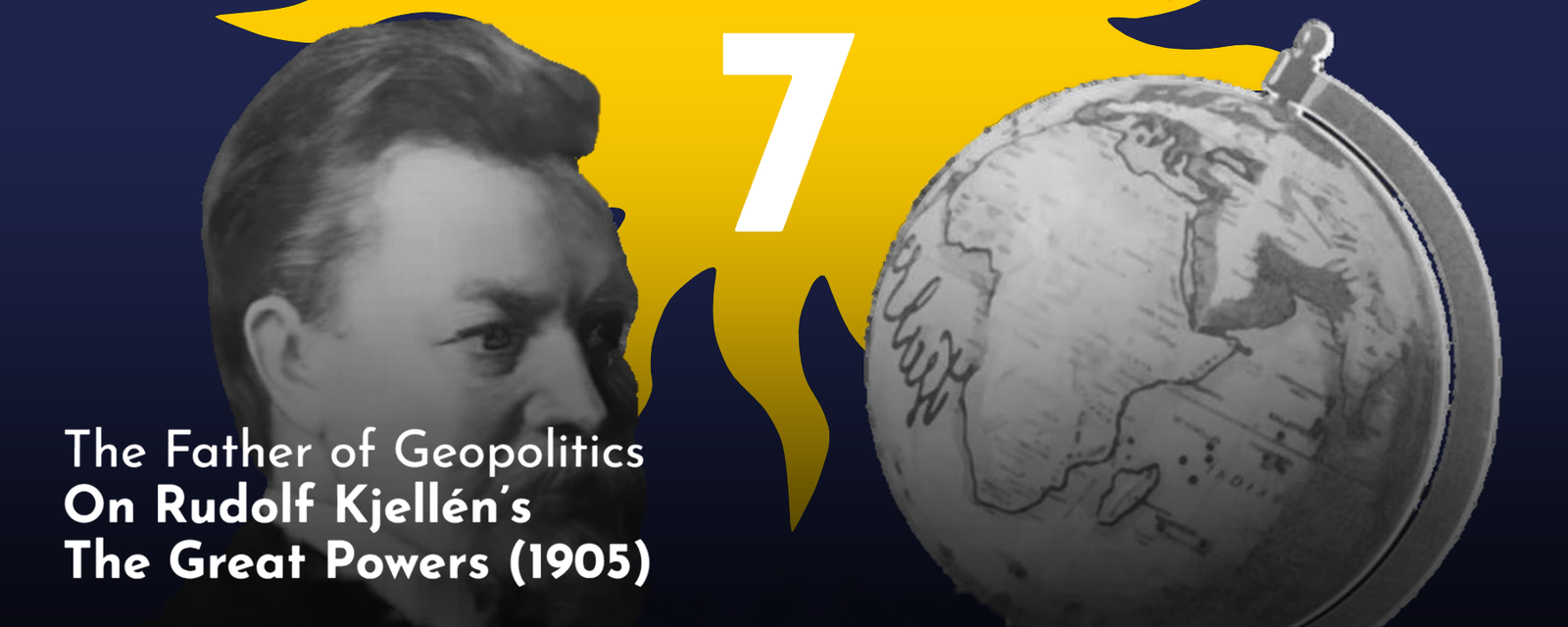
The Father of Geopolitics: On Rudolf Kjellén's The Great Powers (1905)
I. Geopolitik and Biopolitik
Rudolf Kjellén coined the term geopolitik in 1899 and formulated in 1905 a broader politological research programme aimed at studying the state "biologically," through what he called biopolitik. This biopolitical perspective developed over the following decade and reached its fullest expression in his 1916 magnum opus, Staten som livsform (The State as Lifeform).
But what did Kjellén mean by biopolitik? Here it is useful to follow Jean Baudrillard's advice and "forget Foucault." Kjellén's biopolitik should be understood as a holistic, morphological approach to politics, one that conceives of the state as a living phenomenon whose various dimensions can only be understood as parts of an organic whole.
Kjellén identified five interconnected fields that together constituted the biopolitical perspective:
1. Geopolitics - the study of the geographical position and territorial conditions of states;
2. Ecopolitics - the study of economic capacities, resources, and productive potential;
3. Ethnopolitics - the study of population development and the composition of the demographic and ethnic elements of the state;
4. Sociopolitics - the study of the general social conditions and internal organisation of the state;
5. Kratopolitics - the study of constitutional structures and power structures.
For Kjellén, these categories were not independent fields but integral parts of a single whole. They were analogous to organs within a living body, each contributing to the functioning of the whole. But this organic conception should not be interpreted in a materialist manner. Kjellén was a religious man, the son of a vicar, and retained a strong belief in the significance of “spirit,” whether expressed through concepts such as Weltgeist, Volksgeist, or the will to power. Yet neither should he simply be classified as an idealist. For Kjellén, material and immaterial forces were mutually dependent: two dimensions of the same organic reality.
Kjellén thus rejected both materialistic determinism and simplistic idealism. He regarded a purely materialistic understanding of geopolitics as vulgar, but he also rejected the notion that “spirit” could overcome material conditions. His example was the Swedish Empire: full of spiritual vitality, yet ultimately undermined by an insufficient material base. The biological organism of the state must therefore continuously transform and utilise both its material and immaterial resources according to its geopolitical circumstances and internal conditions.
II. The Great Powers and the Planetary Situation
Stormakterna (The Great Powers) placed Kjellén on the international intellectual stage. The work consists of two parts: in the first, Kjellén examines the European great powers; in the second, the extra-European great powers. The purpose here is not to provide a complete summary of his analysis of each individual power, but rather to highlight some of the central themes and conclusions that emerge from the work as a whole.
The opening chapter of the first part is titled “The Planetary Situation,” and Kjellén begins by reflecting on the role of the political scientist. The scientist, he argues, does not share the journalist’s impulse to be the first to report an event, because the scientist is not concerned with rumours or appearances. Nor is the scientist comparable to the diplomat, who, despite formal impartiality, remains a participant in political affairs, bound by interests and therefore always approaching reality with a palette and brush already in hand. The scientist, according to Kjellén, is defined by a respect for facts themselves and by freedom from ulterior motives. His first task in every case is to penetrate beyond appearances and reach the underlying reality of the object under investigation. As Kjellén says:
“But he cannot stop there. He is something more than merely a conscientious hunter of news items. His respect for fact rests on a deeper conception of reality. In it he sees a snapshot of a continual becoming, governed by the law of transformation... In the face of such a view, all isolated facts disappear. A fact exists only in its connection with other facts. In and of itself it is worthless; it gains value and truth only through its context. To examine that context, to reconnoitre the scene on which the day's events are played out, to trace their roots into the past – this, then, becomes the scholar's method in the case at hand. Only thus can one hope to reach vantage points from which to gain a proper perspective on events, so that they do not, like objects held too close to the eye, appear in distorted proportions.”
For Kjellén, therefore, the political scientist requires both breadth and precision: the ability to observe individual facts carefully while simultaneously placing them within a much wider – historical and geopolitical – framework. Thus his objective in Stormakterna is to comprehend the aforementioned “planetary situation” – the historical emergence of the world order and the constellation of power that existed at the beginning of the twentieth century.
What follows is a sketch of the historical development and the laws that govern it. For Kjellén, the fundamental law of historical development is the movement between separation and unification. In the earliest stages of political development, communities were governed in isolation. History began as a collection of local histories with only limited interaction between them, a condition which, in his view, remained visible in Africa while also surviving in residual forms among more advanced peoples and modern state systems.
Kjellén illustrates this early stage through a historical reference to the Law of Västergötland, which governed parts of early medieval Sweden. Under this legal order, native Goths possessed full legal protection, while foreigners – whether from other parts of Sweden or beyond its borders – held progressively weaker forms of legal recognition. The law was structured according to degrees of kinship: other Swedes occupied the closest position, followed by the wider Germanic-Scandinavian world, while all others stood at the lowest level. For Kjellén, this represented an early stage of “separation” which gradually transformed into wider forms of political unity through expanding networks of kinship and solidarity. These developments ultimately contributed to the emergence of the European state system.
From this foundation, Kjellén traces the development toward the modern planetary order. This process unfolded in two major stages:
1. The unification of the European world into a system of states;
2. The integration of the continents into a shared cultural and economic system under European leadership.
The European state system emerged from the consolidation of smaller medieval political units into larger territorial ones around the sixteenth century. The global political system, in turn, developed as European interests and European civilisation expanded across the world during the Age of Discovery.
Technological progress made unprecedented global integration possible, but it simultaneously created a new dependence upon the resources of the wider world. This dependency resulted from the transformation of economic production and social demands following the Industrial Revolution. Population growth and rising social demands transformed industry into large-scale mechanised production, expanding European markets into genuinely global ones. Raw materials became increasingly central to sustaining this new economic order. The interests of commerce therefore bound the world together, and its demands became increasingly “dictatorial” – supported domestically by modern mass society and internationally by military force.
Kjellén therefore argues that anyone seeking to understand international politics must begin with the great powers, since the major questions of world politics are inseparable from the relations between them. By examining their historically established spheres of interest alongside their geographical and natural conditions, it becomes possible to identify points of friction, whether dormant or already developing. These points of friction are where international tensions take shape and where the underlying structure of world politics is most clearly revealed.
III. The Great Powers of History: The Factors Underpinning Their Rise and Fall
The principle of separation and unification is further developed in the second chapter of Stormakterna, where Kjellén examines previous great powers throughout European history. Kjellén argues that great powers rise because they fulfil particular historical functions; they become instruments of history and maintain their prominence only so long as they remain suited to the task given to them by historical development.
Spain, for example, served as an intermediary between Europe and America but declined when history found a more suitable candidate for this function in England. Kjellén thought Spain’s limitations were partly due to geography. The Iberian Peninsula, with its mountainous terrain, hot climate, central plateau, and relatively poor coastline, was in many ways “a piece of Africa transplanted into Europe.” For Kjellén, this geographical structure helped to explain Iberia’s long history of Moorish rule and its limited ability to sustain maritime supremacy. England, by contrast, had an abundance of harbours and direct maritime connections to the European heartland, making it far more suited for global commercial and naval expansion. Spain’s rise was therefore, in Kjellén’s view, the product of favourable historical circumstances rather than of a permanent structural advantage.
The Netherlands, meanwhile, illustrates what Kjellén interprets as Ratzel’s law of rapid rise and rapid decline. Like Carthage, the Netherlands possessed enormous commercial and maritime power but lacked the territorial foundation necessary for long-term great power status. Maritime interests could create rapid expansion, but they could not endure indefinitely without sufficient political and geographical depth behind them. Holland possessed extensive colonies but lacked the sufficient home territory required to sustain them against larger powers such as England and France. Kjellén agreed with Treitschke that a great power without land was a contradiction because a balance between homeland and colonies was necessary for lasting strength.
Kjellén compares Sweden's period as a great power with that of Rome and the Ottoman Empire in terms of territorial ambition, although he regards Sweden as morally superior to the Ottomans on account of its Lutheran faith and because the wars it waged were, in his view, largely defensive in character. Nevertheless, he argues that Sweden's historical weaknesses – its limited commerce, its tendency to live beyond its economic means, and its weak material base – made its position as a great power inherently temporary. For all its spiritual vitality, Sweden lacked the material resources necessary to sustain world historical significance over the long term.
Despite the seemingly "mystical" language of historical destiny, Kjellén nevertheless draws scientific lessons from the rise and decline of great powers. Their strength depends upon a combination of factors: geographical position, territorial extent, natural frontiers, national cohesion, concentrated political authority, and economic prosperity. Above all, a great power must maintain a balance between its political and social development. Together, these conditions determine not only the kind of power a state can become but also the trajectory of its rise, decline, and eventual fall.
Destiny, therefore, is not an arbitrary mystical force. It rather signifies the probable outcome of a state's historical development and of its capacity to harmonise the moral and material forces that constitute it as a political organism.
IV. The Evolution of the Planetary Situation
The remainder of Stormakterna consists of an examination of the great powers of 1905. The European powers discussed by Kjellén are Austria-Hungary, Italy, France, and Germany; the extra-European powers are England, the United States, Russia, and Japan. He analyses each individual state’s historical development, demographic situation, economic foundations, social conditions, political organisation, and military capacity, applying the structural principles outlined in the previous chapters. His aim is not merely to describe these states, but to identify the underlying strengths and weaknesses that would shape their future trajectories within the emerging planetary system.
The purpose here, however, is not to evaluate Kjellén's individual predictions or to determine in detail where he was right or wrong. Rather, the focus is on those aspects of this century-old work that remain particularly relevant: namely, his conception of the evolving planetary situation and its implications for Europe. Despite his fervent nationalism and strong sympathies for Germany, Kjellén consistently sought to approach international affairs from a value-neutral and "planetary" perspective. His ambition was to transcend normative outlooks and analyse political developments from a historical and geopolitical standpoint, free from what he called "anthropic feeling.”
In my view four aspects of Kjellén’s analysis deserve particular attention:
1. The rise of the United States;
2. Russia and the Eurasian question;
3. The Great Oriental Question;
4. The emergence of planetary powers and the future of Europe.
1. The United States
Several decades before Kjellén wrote Stormakterna, Alexis de Tocqueville had already predicted that Europe would eventually find itself situated between two great continental powers: the United States and Russia. Kjellén shared this view.
He begins his analysis of the United States by drawing attention to the structural similarities between it, England, and Japan. All three enjoyed a degree of geographical isolation, but that of the United States was far greater in scale. Unlike Japan, it was not positioned next to China or Russia, and unlike England, it was not situated next to the European continent. It was, in Kjellén’s view, a distant giant with weak neighbours.
The United States was also unique among the great powers because of its African element. He argued that the country's future development depended in part upon the resolution of what he called the "Negro Question.” He identified two possible outcomes: either the United States would become a genuine melting pot through the further expansion of egalitarian principles, or it would preserve a rigid racial hierarchy. For Kjellén, this was not merely a domestic issue but a geopolitical one, because the internal organisation of a state determined both its capacity for action and the manner in which it acted. He applied the same logic to the nationality question in Austria-Hungary.
Another feature distinguishing the United States from the European powers was that, according to Kjellén, it possessed no organic necessity for further external expansion. By 1905, the United States had already established a continental empire within its own borders. Any additional expansion would therefore be artificial rather than a natural continuation of its historical development. Here Kjellén employed a distinction later associated with Spengler between Kultur and Zivilisation: he regarded the United States as rich in material civilisation but lacking the deeper cultural and historical foundations possessed by older European peoples.
Nevertheless, one conclusion was beyond doubt for Kjellén: the internal cohesion of the United States, combined with its immense natural resources, industrial capacity, and economic potential, meant that its influence would increasingly overshadow a fragmented Europe. In his view, the United States was a planetary power in the making, destined to achieve global significance within a matter of decades.
Kjellén highlighted this development by quoting nineteenth-century European statesmen who had recognised the "American peril":
“As early as 1878, Gladstone predicted that the great Union would inherit England's position as the ‘chief supplier to the world's household.’ ‘We have,’ he said, ‘no greater privilege against America than Venice or Holland had against us.’ In 1897, the President of the Board of Trade, Ritchie, declared America's competition to be ten times more dangerous to England than Germany's; and by now it would seem that British public opinion has resigned itself to this rival as to a force majeure.”
For Kjellén, the significance of the United States was therefore not merely economic or military, but structural. It represented the emergence of a new type of power: continental in scale, economically self-sufficient, and capable of operating beyond the confines of the traditional European balance of power system.
2. Russia
Russia's defeat in the Russo-Japanese War, brought the question of Russia's position in world politics to the forefront. For Kjellén, East Asia would increasingly become one of the central arenas of future geopolitical competition, shaped by the interests of Japan, the United States – which had established a presence in the region after its victory over Spain – and Russia.
Like the United States, Russia had developed largely in isolation from broader European historical trends. Kjellén identified several structural similarities between the two powers: their immense territorial scale, geographical separation, and complex demographic questions. Yet there was also a crucial difference. Whereas the United States was gradually integrating a diverse population into a common political identity, Russia had, in Kjellén's view, failed to organically unite its non-Russian peoples. Rather than moving towards integration, many groups within the Russian Empire were instead oriented towards separation.
Kjellén believed that representative government would ultimately prove incompatible with Russia's internal structure, because the empire lacked the social and national cohesion required for such a system. He cited an observation that historically Russian monarchy had been checked only by regicide, while the modern Russian state had effectively become a bureaucracy limited only by corruption. These structural, historical, and cultural factors made any form of federalism impossible in his view. Thus, Russia was destined towards Caesarism.
The monarchical character of the political structure was also reflected in the Russian economy. The country remained heavily dependent upon agriculture and raw materials, and even as industrialisation accelerated, the fruits of economic development remained concentrated in the hands of a small elite. Kjellén therefore saw a contradiction between Russia's adoption of Western forms of material modernisation and the deeper social and political realities of Russian civilisation. Modernisation was taking place without organic transformation – what Spengler would later call pseudomorphosis.
The same logic applied to Russian imperial expansion. Kjellén identified several directions of Russian ambition: towards the Atlantic, Constantinople, India, the Indian Ocean, and the Pacific. Yet he regarded these ambitions as lacking genuine biological necessity. Unlike expansion driven by economic demands, population pressures, or the pursuit of vital resources, Russian expansion was, in his view, primarily an expression of state power. As such, he considered it artificial rather than organically driven, much like any future expansion of the United States.
Nevertheless, Kjellén did not deny Russia a world historical role. Regardless of its internal political form, the geopolitical organism of Russia guaranteed its status as a great power. In an age characterised by the emergence of a "new Asia" and the possible future unification of Europe, Russia would serve as the great intermediary and buffer between the civilisations and peoples of East and West.
3. The Great Orient
The world historical significance of East Asia, in Kjellén’s view, began with Japan’s rise and its conflict with China over Korea during the 1890s. By 1904, Russia had entered the struggle for influence in East Asia, only to suffer defeat at Japanese hands. Kjellén thought that despite China’s subordination to the Western powers and Japan, the brewing European disaster meant that one could not exclude the possibility of an Asian resurgence.
China, despite its weakness in 1905, possessed all the fundamental characteristics required to become a future planetary power. Kjellén described it as a “broad-based type” – a state whose geographical, historical, cultural, and demographic conditions provided exceptional long-term advantages. China possessed an enormous territorial foundation, favourable climate, abundant resources, a highly developed civilisation, a deep historical consciousness, a vast and largely homogenous population.
China was therefore a sleeping Leviathan. It possessed the potential to follow the path of Japan, transforming its civilisational and natural resources into modern state power. At the same time, he believed Europe’s fragmentation and internal conflicts created the possibility that the centre of world politics might gradually shift away from Europe toward Asia.
Kjellén argued that the future strength of East Asia would depend upon a possible combination of Chinese resources and Japanese modernisation. Japan possessed industrial capacity, military organisation, and political will, but lacked the territory and resources necessary for lasting great power status. China possessed precisely those resources but lacked industrial and organisational modernity. Kjellén thought that the future required the “soul of Japan” to be placed within “the body of China.”
In this respect, he saw Japan as suffering from the same structural weakness as England and Italy: it was a maritime power with limited territorial depth. Such states could achieve extraordinary influence but remained dependent upon access to external resources.
Kjellén further speculated that Japan's victory over Russia would generate a broader sense of Asian racial and political awakening, weakening the assumption of European superiority. He considered the emergence of an Asian Monroe Doctrine a likely development, animated by the principle that Asia should belong to Asians. However, in the 1920 edition of Stormakterna, Kjellén himself abandoned the expectation of any enduring Sino-Japanese cooperation.
Nevertheless, his broader observation concerning the eventual rise of Asia proved historically correct. China ultimately combined its immense civilisational and demographic foundations with modern industry and technology, emerging as a planetary power later in the twentieth century.
4. The Rise of Planetary Powers and the Question of Europe
For Kjellén, the resources that produce great power status – and which great powers consequently command – can be divided into two fundamental categories: economic power and military power. From this distinction two primary types of great powers can be identified:
1. The economic type, rooted primarily in trade, commerce, and industrial production;
2. The military type, centred upon territorial control and land-based armed power.
The clearest representatives of the economic type were England and the United States, while Russia and Japan represented, in his view, the military type. Powers such as France and Germany combined elements of both and therefore constituted transitional forms.
For Kjellén, however, the decisive question in the future age of planetary politics was not merely the ability to accumulate wealth or project military power, but the capacity of a state to achieve a sufficient degree of self-sufficiency. A power capable of shaping world history had to possess the resources required to sustain its population and preserve its political independence. The conditions of industrial society, combined with demographic expansion and rising social demands, meant that access to territory and resources would become increasingly important.
This represented a gradual transformation in the foundations of power. In earlier periods, control over trade routes and commercial networks could compensate for limited territorial resources. In the emerging planetary era, however, the control of land – and therefore of the resources contained within it – would become increasingly decisive. The political organism possessing the greatest territorial and economic depth would enjoy the greatest advantages.
This logic naturally favoured large continental powers. The larger the geopolitical organism, the closer it came to the ideal of self-sufficiency and, consequently, to the requirements of future world politics. In Kjellén's assessment of the early twentieth-century situation, only Russia, the United States, and China fulfilled these criteria. The European powers, as well as Japan, remained structurally disadvantaged because of their limited territorial foundations and dependence upon external resources.
This led Kjellén to a rather pessimistic conclusion regarding Europe's future. The individual European states, despite their historical achievements and continued strength, would increasingly face geopolitical pressure from larger and more self-sufficient powers. The solution was not for a single European state to achieve continental dominance, as Prussia had done within Germany, but rather for Europe itself to undergo a process of political integration.
The planetary situation of 1905 was, in Kjellén's view, largely a consequence of Europe's own historical success. European expansion had created a global system, but it had also produced competitors capable of challenging European supremacy. No individual European power could realistically compete with continental-scale states possessing populations numbering in the hundreds of millions. Europe could therefore preserve its position only by uniting its separate political entities into a larger whole – much as Sardinia-Piedmont had unified Italy.
Kjellén thus anticipated the decline of an era in which European powers could rely upon monopolies in industry, trade, logistics, and military technology. The future required a new political structure: a European federation capable of competing with the emerging planetary powers. The "United States of Western Europe" would constitute a political organism standing alongside other continental-scale powers.
In this emerging world order, the traditional European great power system would give way to a system of planetary powers. The geopolitical constellation of 1905 consisted, according to Kjellén, of four purely European powers, two semi-European powers, and two extra-European powers. The future, however, would be organised around four major geopolitical entities:
1. A united European power – the “United States of Western Europe”;
2. A Eurasian power centred on Russia;
3. An East Asian power composed of China and Japan;
4. The United States of America.
What united these future planetary powers was their location within the northern temperate zone, which Kjellén regarded as the principal geographical centre of global civilisation and power. He argued that the industrial and political dominance of these northern regions would shape the organisation of the wider world, as the global south remained dependent upon northern economic and technological systems.
From this perspective, Kjellén envisioned a future geopolitical division – or nomos – of the Earth. Africa and the Levant would fall within Europe's sphere of influence; Australia and the Malay-Polynesian world would belong to the Sino-Japanese sphere; and South America would become closely connected to the United States. India, he speculated, might eventually enter the Russian sphere, granting Russia influence over the Indian Ocean alongside Europe and China. Meanwhile, the United States would share maritime influence over the Atlantic with Europe and over the Pacific with East Asia.
Whether his projected world order – which proved only partially accurate – represents merely a historical curiosity or an unfinished trajectory remains, of course, an open question. What ultimately matters, however, is the analytical framework that led him to these conclusions. Kjellén recognised that the twentieth century would not simply extend the nineteenth century's European balance of power politics, but would instead inaugurate a new era in which continental-scale political organisms competed on an increasingly global stage for the resources required to secure their self-preservation, expansion, and ultimately their survival.
Lucas
FounderAve Europa Finland