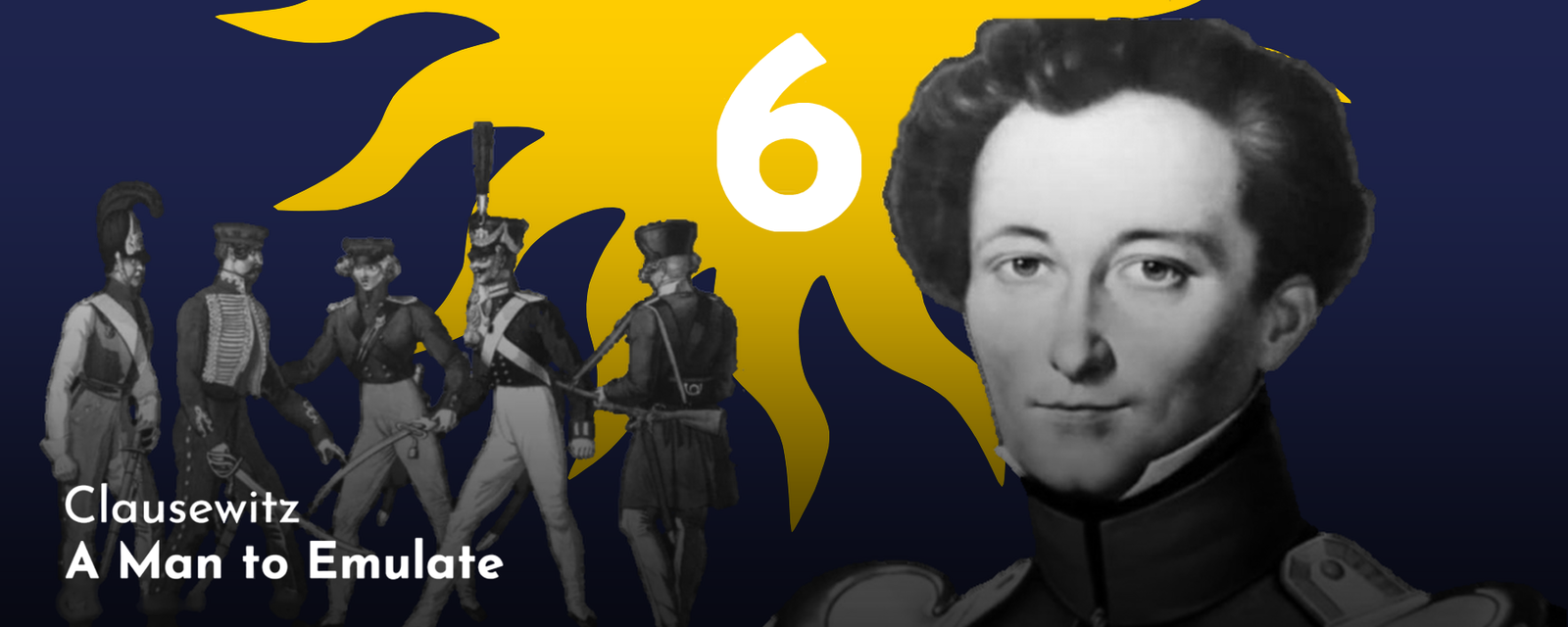
Clausewitz: A Man to Emulate
Clausewitz began his service in the Prussian army as an ensign in 1792 at the age of twelve. He died a general after a successful career at the age of fifty-one in 1831. Between 1792 and 1831, the only formal education he received was that of the military academy; the rest he owed to practical engagement with the world and extensive studies of history, philosophy, and related subjects on his own.
The detached engagement of the self-taught - or the autodidact - is seemingly a major prerequisite for a clear and descriptive mind. The scientist cannot be a moralist, nor can he be a conformist, shackled to the routines and wishes of institutions. Yet the self-taught man cannot and must not imagine that he possesses the Truth. The practical man must find a balance between these two dispositions, and by extension, he cannot truly be claimed by any party.
"Do not worship decrepit buildings or the debris left behind by the palaces of old." As Prussia collapsed and the French occupation began, Clausewitz, despite his spiritual distress, remained calm and courageous, for he had reconciled himself to fate and remained true to his principles. He had no qualms about criticising that which he loved: his people and all of Germany. As he wrote:
"The mentality of the Germans seems to become more and more deplorable, one sees manifested everywhere such a lack of character, such a weakening of the spirit that it nearly brings tears to the eyes. I write this with infinite sadness; for there is no man in the world who values more than me the honour and dignity of his nation; but one cannot delude oneself about a phenomenon that no one could deny."
A spiritual phenomenon is simultaneously a social phenomenon. By extension, all spiritual phenomena influence political phenomena and may even become fully political in themselves. This insight stemmed not only from Clausewitz's study of history but was made most evident by the French Revolution. By revolutionising society, the state was able, as never before, to harness the energies of society for war.
Thus Clausewitz understood war as inseparable from the broader life of society. Political, social, military, and spiritual forces continually act upon one another, and none can be understood in isolation. The statesman and the soldier alike must recognise this interdependence if they are to effectively realise their goals.
Despite these realities, Clausewitz remained, for all intents and purposes, unideological in matters of politics and society. This same detachment is reflected in his undogmatic study of war. The theorist - whether of society, politics, history, or war - must not confuse moral judgement or normative commitment with understanding. Politics cannot be studied apart from power, nor war apart from violence. Only by confronting them as they are can one begin to understand the forces that shape history.
Theory and practice are two different things, but the faculty that mediates between them is understanding. Because every concrete situation differs, theory cannot substitute judgement. Therefore, no good theory reduces itself to doctrine. As Clausewitz wrote in On War, his aim "is not to provide new principles and methods of conducting war; rather we are concerned with examining the essential content of what has long existed, and to trace it back to its basic elements." Later on he said:
"We cannot formulate principles, rules, or methods: history does not provide a basis for them. On the contrary, at almost every turn one finds peculiar features that are often incomprehensible and sometimes astonishingly odd. Nevertheless it is useful to study history in connection with this subject as with others. While there may be no system, no mechanical way of recognising the truth, truth does exist. To recognise it one generally needs seasoned judgement and an instinct born of long experience. While history may yield no formulae, it does provide an exercise for judgement, here as anywhere else."
Finally, Clausewitz argued that any proposition concerning war, politics, or society is best illustrated through history: "Historical examples clarify everything and also provide the best kind of proof in the empirical sciences. This is particularly true of the art of war." Indeed, every theory is ultimately tested by history, and it is only by bringing theory into dialogue with history that genuine intellectual advancement becomes possible.
A theory rooted in history is also anthropological, and therefore cannot be separated from the concrete realities of human life. The concepts produced by historically grounded theory may appear "abstract" or "pure" precisely because they are ideal types extracted from a multiplicity of particular cases. These ideal types can be said to be the structural features underpinning war: conceptual constructs that assume different forms depending on when, where, and how the existential struggle is waged.
Examples of such structural features - or concepts - are hatred, enmity, violence, and the enemy. Theory is not concerned with particular manifestations of enmity or with the different forms enemies may take. Rather, it seeks to identify the underlying structural element that unites these particular expressions.
Lucas
FounderAve Europa Finland