Gonzague de Reynold: the Counter-Revolutionary Switzerland
The following text is a translation by @vvild5 of an interview conducted by Florimond du Bessay d'Otegem with the Swiss editor Xavier Meystre. Said interview was published in the French Catholic blog "Le Salon Beige."
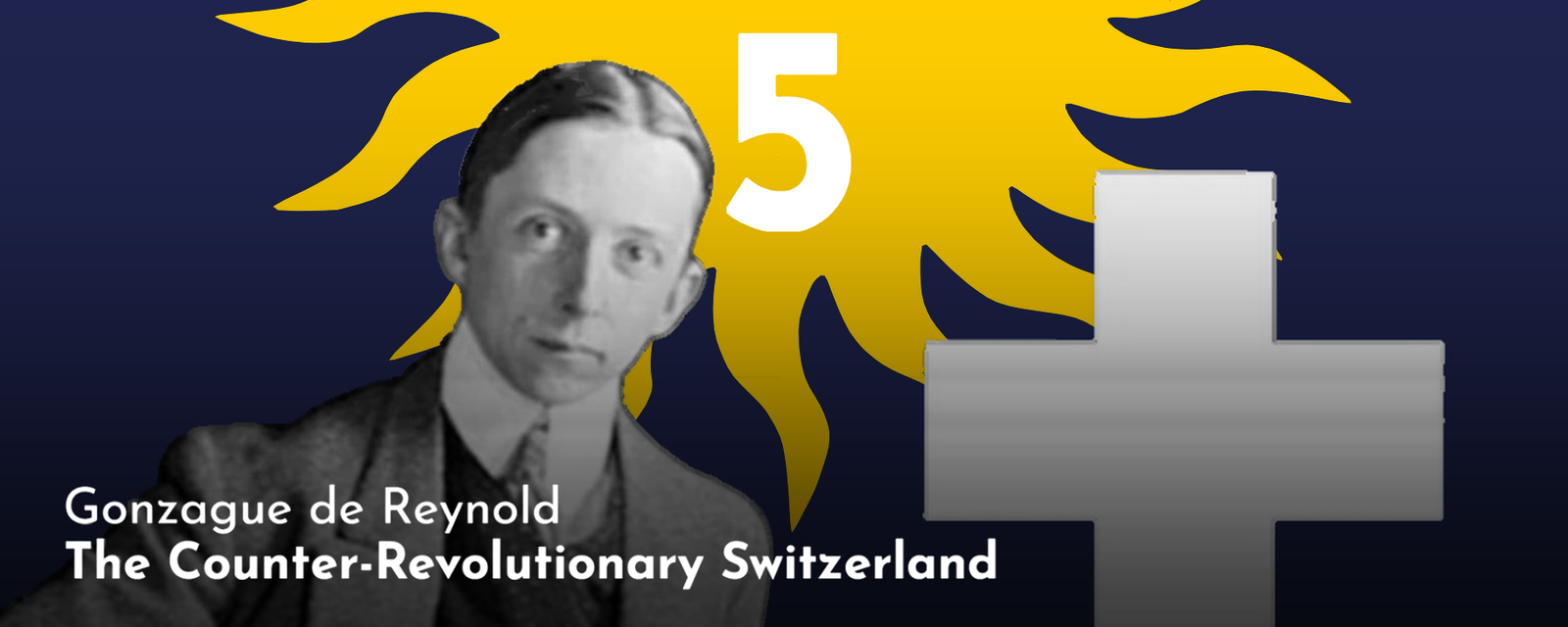
Xavier Meystre is a Swiss editor and content creator. He is currently republishing L'Europe Tragique by his fellow countryman Gonzague de Reynold (1880-1970) and organizes the annual Salon Gonzague de Reynold, which he founded. This summer, he kindly and courteously agreed to answer our questions about this thinker who inspires him so much—a major yet little-known figure of the counter-revolution in Switzerland in the 20th century.
Q : Gonzague de Reynold is a very little-known thinker in France. Could you introduce him to us?
X. M. : Gonzague de Reynold is a Swiss counter-revolutionary thinker and writer. He was born on July 15, 1880, in Fribourg and died on April 9, 1970, in Cressier, at his château. He was the son of Baron Alphonse-Marie, a dragoon captain, and Nathalie-Victorine de Techtermann. During his adolescence, from 1891 to 1899, he studied and earned his baccalaureate at Collège Saint-Michel in Fribourg, a venerable institution that still exists, founded by Saint Peter Canisius during the Counter-Reformation. He then studied at the Sorbonne and the Catholic Institute of Paris from 1899 to 1901. He completed his education with a period at the University of Freiburg in southern Germany and received his doctorate from the Sorbonne in 1909.
Upon returning to Switzerland, he became, along with Charles-Ferdinand Ramuz and the brothers Alexandre and Charles-Albert Cingria, one of the leading figures of the literary and poetic renewal movement of the Belle Époque, embodying the spirit of that pre-war generation. However, being short on money, this bohemian lifestyle did not allow him to make a living. He managed to get by working as a private lecturer and later as a lecturer at the University of Geneva starting in 1909.
In 1914, concerned about the looming war, he founded the Nouvelle Société Helvétique with a few friends, a name reminiscent of the Société Helvétique of the 18th century, which had been the origin of the modern Swiss national spirit. This organization (which still exists today) aimed to defend Switzerland's core values, such as its army, neutrality, federalism, and, of course, its Christian heritage.
During the war, he was called upon by General Ulrich Wille, the commander-in-chief of the Swiss army, to serve as the head of the Army Conference Bureau. This position allowed him to wield intellectual influence, as it involved instilling in soldiers and officers throughout the army a sense of their history and culture in a patriotic spirit. It was during this time, in 1915, that he was appointed full professor of French literature at the University of Bern.
He was a brilliant professor who enjoyed great success, attracting students from far and wide to attend his lectures. Even Walter Benjamin briefly studied under him and didn't seem disturbed by his views. However, opposition arose against the flamboyant professor, a man of letters and poet with counter-revolutionary ideas. This culminated in a scandal in 1931, following the publication of his book La Démocratie et la Suisse. Reynold accepted an offer from the University of Fribourg, his hometown, where he taught from 1932 to 1951.
As a reminder, the University of Fribourg's foundation dates back to 1889. On October 4, 1889, the Grand Council of the Canton of Fribourg decided to grant full powers to the Council of State to prepare the provisional opening of one or more faculties of the university. State Councillor Georges Python, a great Catholic politician from Fribourg, was the main driving force behind this achievement, fulfilling the long-held aspiration of Swiss Catholics to have their own university.
Q : Which authors influenced his thinking?
X. M. : Reynold was fundamentally influenced by the teachings of the Church, to which he remained faithful throughout his life. This, of course, includes loyalty to the philosophy of Saint Thomas Aquinas. However, he wasn't really a philosopher and certainly not a theologian. In his youth, he was greatly influenced by poets and major French writers like Chateaubriand. He was steeped in French culture and classical French literature, due to both family tradition and the influence of Catholic schools, such as the Saint-Michel College in Fribourg where he had been a student. At the same time, he was also very drawn to the Romantics, including the German Romantics.
Politically, he was influenced by Maurras and the ideas of Action Française, though he maintained a certain distance, as he wanted to reference a "Swiss spirit," an original path for Switzerland—a country with both Germanic and Latin cultural influences. He was always deeply attached to this Swiss genius, which allowed for the blending of these two cultures, each with its own strengths. This led to heated debates between him and his fellow young writers around 1900, such as Charles-Albert Cingria, who viewed things primarily through a Latin lens. Yet, it was Gonzague de Reynold who came up with the title La Voile Latine for the famous literary journal founded by these young, innovative writers. When Action Française was condemned by Pope Pius XI, he obeyed and distanced himself from the movement, though he still kept a signed photo of Maurras on his desk until the end of his life.
Q : What is particularly interesting about this author?
X.M. : Along with [Karl Ludwig von Haller] at the end of the 18th and beginning of the 19th centuries, Reynold is a central figure of counter-revolutionary thought in Switzerland during the 20th century. He is radical—meaning he goes to the root of things in terms of doctrine—but moderate in the sense of being measured. He is not a writer or thinker who rants, and he never resorts to vulgarity. In this sense, he is a great defender of courtesy, elegance, and the values of the Ancien Régime, which is appealing when living in a decadent era like the one we are experiencing today.
Personally, I belong to a generation that never heard of Gonzague de Reynold, either in school or university, except to criticize him. Like others from my generation, reacting against the trends of the time that I dislike, I have rediscovered this author, who is not well-regarded by leftist intellectuals but still holds an aura in Swiss opinion.
Q : Gonzague de Reynold was a militant royalist. Isn't that surprising for a Swiss?
X. M. : One cannot say that Gonzague de Reynold ever advocated for a hereditary monarchy in Switzerland, as that wouldn't have made sense. Instead, he was part of a current of thought that sought to revive the role of Landammann, the figure who officially represented the Confederation in old Switzerland (the title of Landammann is still the official designation for the head of state in several German-speaking cantons of Switzerland). This idea was not adopted, but one could argue that the personality of General Guisan, the commander-in-chief of the army during the war, effectively fulfilled this unifying leadership role that patriots would have liked to see embodied by a Landammann.
For countries other than Switzerland, Gonzague de Reynold was an advocate of monarchy. He was, by family tradition, a monarchist for France, and as mentioned earlier, Maurras influenced him. The term "militant" seems a bit strong, but indeed, as a Thomist, he states in L'Europe Tragique:
"The best form of government, for Aquinas, is therefore hereditary monarchy, supported by an aristocracy and limited by a democracy. A king, that is, a unifying and responsible leader, whether hereditary or elected, an elite of magistrates and high officials, and above all social authorities, chosen from the people organized corporately, as it was in the Middle Ages." – (Revised ed. 2024., Gonzague de Reynold, L'Europe Tragique, Les Éditions Meystre, p. 384).
Q : What influence did Count de Reynold have on his contemporaries? What is his significance in Switzerland today?
X. M. : During his lifetime, he exerted a strong intellectual influence, and perhaps even a political one behind the scenes. This is precisely what leftist historians criticize him for, as they recognize that there were movements of thought in Switzerland between the wars that sought a renewal of institutions in a national sense, often sceptical of liberal democracy. This topic is controversial because some historians portray Gonzague de Reynold as the main inspirer of an authoritarian and traditionalist right, while others downplay his role in this movement.
Recently, correspondences from Federal Councillor Philippe Etter, a conservative Catholic aligned with corporatist thought, were discovered. He wrote to his friend Gonzague de Reynold about the project of Spiritual Defence of Switzerland, an official policy pursued by the Swiss authorities during the war, mentioning how much this project was influenced by their conversations. Immediately, the leftist intelligentsia seized upon this to assert that Gonzague de Reynold was the main inspirer of Swiss policy during the war, which indeed had a rather authoritarian and national tone. However, it's important to remember that Spiritual Defence was not very ideological and included both socialists and individuals who could today be classified as far-right. It was a unifying political concept, referring to history, that was necessary to create a sacred union during the war behind the army, the defence of independence, and neutrality. Given that Councillor Etter mentioned it, it's likely that Gonzague de Reynold had some influence in defining this policy, proving at least that he was capable of being a unifying figure.
After the war, Gonzague de Reynold went through a kind of purgatory as the atmosphere had shifted. However, he quickly bounced back by writing his influential seven-volume work Formation de l'Europe. His voice continued to be heard until his death, even if it often contradicted the prevailing consensus. He founded an institute in Fribourg to promote culture in his beloved canton and helped address the thorny issue of language coexistence in the region. In the 1960s, staying true to convictions he expressed in his youth, he passionately supported the cause of autonomy for the Canton of Jura, which put him at odds with the official stance of Switzerland. Yet history vindicated him, albeit after his death, as Swiss politics eventually accepted the creation of the Canton of Jura in 1977, a decision ratified by the people in a referendum.
Unfortunately, at present, it must be said that the influence of Reynold's thought is very weak. First, since fewer and fewer people read or take an interest in those who came before us, it is difficult to make him known. Second, we are living in a time of lukewarmness and Orwellian lack of courage. The consequences are such that many hesitate to quote Gonzague de Reynold for fear of being categorized. Nevertheless, I have created and host a literary and political named in his honour, which takes place once a year in Switzerland, in January, during the WEF. A humorous anecdote: at the last edition, a lady asked me, "Are you Gonzague de Reynold?"
Q : What were Gonzague de Reynold's connections to France?
X. M. : His ties to France were numerous and deep. He came from a Swiss family of officers who had distinguished themselves in the service of France, which is where many cherished memories and traditions that connected him to the country originated. For example, he was very proud that one of his ancestors, François de Reynold, had served under Louis XIV, gloriously participated in the War of the Spanish Succession, and later became a member of the war council under the Regency with the rank of lieutenant general. He lived in Versailles and was mentioned several times in Saint-Simon's memoirs. This family had been ennobled in France and could have claimed French nationality since Louis XIV granted them letters of naturalization, which in modern terms means citizenship.
Gonzague de Reynold studied at the Sorbonne under Joseph Lanson, one of the prominent masters of the institution at that time. Throughout his life, he maintained connections with French poets and writers, particularly Francis Jammes and Paul Valéry, who were his friends, among others. He was close to right-wing Catholic writers such as Georges Goyau, a member of the Académie française, and Henri Massis. He was a corresponding member of the Institut de France and a knight of the Legion of Honour. Throughout his life, he gave countless lectures in France. All of this created numerous familial, intellectual, and various other ties to the country.
Q : How can reading this deeply Swiss thinker be interesting for the French?
X.M. : The question should rather be: how could reading this thinker not be interesting? I firmly believe in what Juan Donoso Cortès called Catholic Civilization. Switzerland, contrary to what is often written, is not immune to globalization and the destruction of European nations. Therefore, to understand and combat these evils, we must address the roots to eliminate the problem. Ultimately, in order to fight, we need to unite behind a common cause and understand the unique characteristics of each country, distinguishing what sets France apart from Switzerland, for example. Thus, it is essential to know and read the classics of neighbouring countries.
Q : To conclude, which works would you recommend to someone wanting to get acquainted with this thinker's oeuvre?
X.M. : His work is quite diverse, including poetry collections, historical studies, literary history, and even plays. In my view, his most political work is L'Europe Tragique, which I am particularly interested in politically, which is why I wanted to republish it. In this book, he "studies the revolution whose distant origin is humanism, which culminates with the French Revolution and ends, shattering, with the Russian Revolution and the economic crisis. In the second part, he addresses the early symptoms of counter-revolution in Italy and Germany. Finally, he analyses the need for unity that troubles the contemporary world, striving to reconnect it with its spiritual principle, which is his conclusion". There are also La Démocratie et la Suisse and La Fromation de l'Europe, mentioned earlier. This latter work has been republished by Éditions Meystre and will be available for pre-order on September 1 and for general order starting October 1.
Martin
Guest WriterAve Europa Switzerland