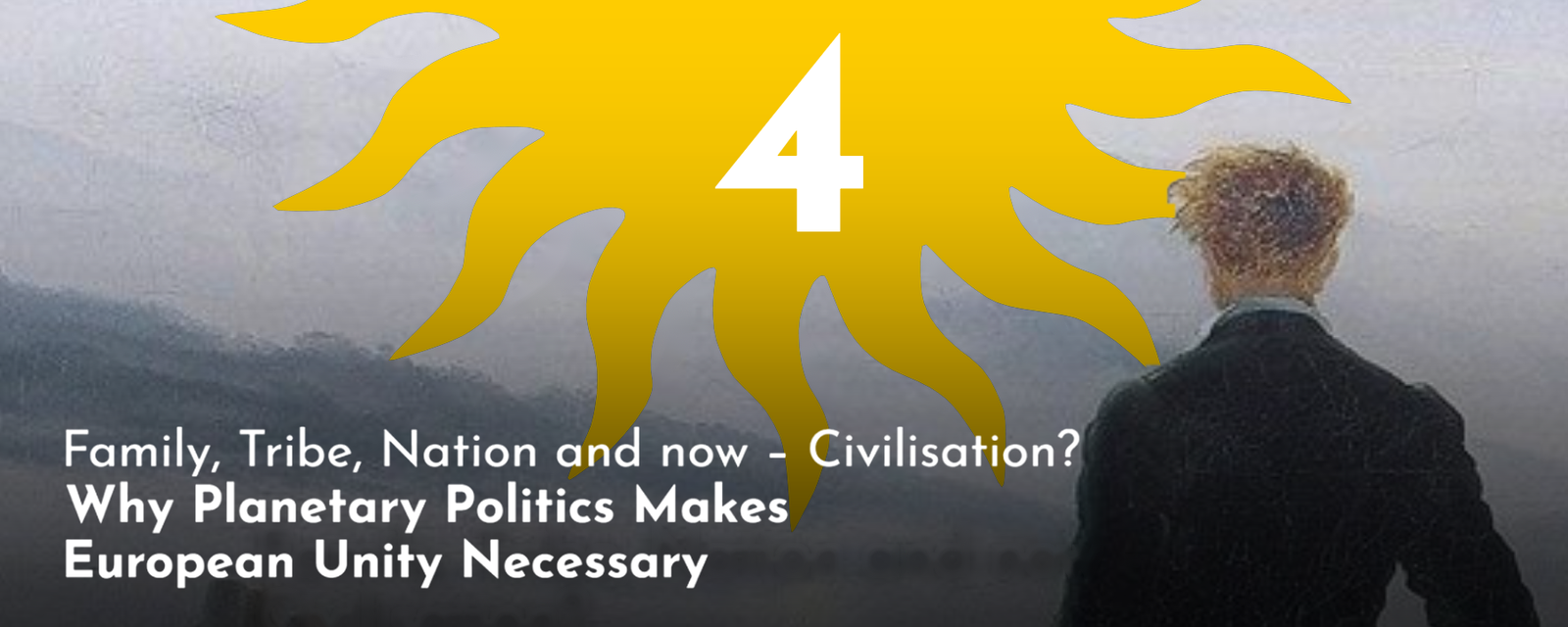
Family, Tribe, Nation and now - Civilisation?: Why Planetary Politics Makes European Unity Necessary
We live in an era marked by unprecedented social, political, demographic, economic, and technological change. The accelerated pace of late modernity leaves little room for sustained reflection; instead, individuals are compelled to remain in constant motion, adapting to shifting circumstances and new, emerging paradigms. As a result, customs and traditions often lose their normative force, since the constant transition from one experiential framework to another renders them seemingly obsolete. The present becomes increasingly detached from the past, and collective attention turns toward the future – toward what remains unknown.
Within Europe – and the Western world as a whole – this orientation toward the future is structured by a particular horizon of expectation, characterised by commitments to progress, liberty, democracy, and human rights. These concepts function not merely as political ideals but as foundational assumptions that shape public discourse and collective self-understanding. Yet there has in recent times been an ever-increasing questioning of their underlying assumptions. For decades, raising questions about these norms provoked unease and resistance; in the past few years, however, such questioning has become far more common.
To examine these values, though, is not to advocate their negation. Questioning the meaning of progress, liberty, democracy, or human rights does not entail endorsing regression, oppression, authoritarianism, or injustice. Rather, it involves examining the content ascribed to these concepts. Does liberty signify the unrestricted fulfillment of individual desires – that is, hedonism – or does it refer to a form of self-mastery and freedom from domination by one's own desires? Does democracy denote simple majority rule, or does it imply the protection of fundamental rights that may limit majoritarian power and entrench a particular normative order under the guise of legalism? Perhaps the most ambiguous of these concepts is progress, which everyone across the political spectrum claims to aspire toward, regardless of their ultimate ends.
A critical engagement with these concepts therefore requires more than affirming them as abstract goods; it demands clarification of their substantive meaning and their origins. Only through such reflection can contemporary European societies avoid reducing foundational ideals to unexamined slogans, and instead preserve their philosophical, political, and civilisational significance. This task is more urgent than ever in Europe, where the current invocation of these values not only undermines them in the long run but threatens to erode the very civilisational framework that gave rise to them in the first place. Indeed, the present crisis is itself a product of the current constellation and the reigning order. This is why we live in an age of critics demanding change – an age in which more and more Europeans seek to reorient our values toward something constructive, something truly European, and toward a European future. This is for instance where Ave Europa wants to make its mark.
The invocation of "European values" presupposes a definition of "Europe" and "European," together with a historical account of how these values emerged. It also presupposes a distinction from, say, India, China, or Russia, and correspondingly from "Indian values," "Chinese values," and "Russian values." Yet to speak of Europe, Russia, and China – and of European, Russian, and Chinese values – is also to imply some form of universality that unites these particulars while preserving their distinctness. The invocation of China implies not only the spatial entity we conceive of as China, but also the Chinese people; the same holds for Russia, where we speak of both Russian space and the Russian people. When it comes to Europe, this question becomes considerably more complex, a matter addressed later.
If values and civilisations presuppose a space and a people, then values are inseparable from the space and people who produced them over time. This is why "European values" cannot be separated from Europe, Europeans, and European history – just as Confucianism cannot be separated from the Han, China, and Chinese history. Ideas do, of course, take on a life of their own, but it would be a fatal mistake to cut them off from their origins and their embeddedness in historical organisms. This is all the more important in what is now a quasi-European world. European history became world history, and this is why European forms permeate the globe – a fact that may give the illusion of pure universality, but this is mistaken. Over the decades, we have seen that while European forms may persist, their content is everywhere becoming less and less European. The supposed universality is in fact European, not "humanitarian" or "for mankind as such." In a world where identitarian, nativist, and even civilisational modes of thought and assertion are growing everywhere, it becomes ever more important for Europe finally to consolidate itself, root itself, and orient itself on concrete, historical, and civilisational terms vis-à-vis the rest of the world.
This is due to the fact that man is a terrestrial creature, but he is not limited to land as such. He is a creative being: he conquers sea and air, and can even reach for the stars. Moreover, he can construct new forms of space, such as cyberspace. He is a spatial being who draws boundaries, for without them he would be nothing. Boundaries produce differentiation, and therefore recognition – they produce identity. The land determines man, and man determines it in turn. By appropriating the land, man and his community grow into it, and in setting root, they produce culture. This relationship is not fixed; it is constantly developing and evolving. Culture and ideas are of central importance, for it is only through them that man can order both the people and the space itself. Aristotle, in his Politics, dwells on this topic in Book II, Chapter 6. The Spartans appropriated the land with the cultivation of military excellence in mind, and this produced Spartan culture, Spartan legal and political structures, and a distinctly Spartan form of life. Later, in Book IV, Chapter 3, Aristotle goes on to discuss the fact that not just any constitution works – there is no such thing as "the best system of norms" in the abstract. A constitution cannot simply be imposed from the outside; it must meet certain concrete criteria, corresponding to the economic structures, the distribution of wealth and power, the social-cultural-ethnic composition, the military organisation, and the spiritual or moral character of the community as a whole. This is because the enforcement of abstractions breeds alienation, and alienation breeds division and strife. This is why, in Chapter 4, Aristotle goes on to weigh the respective strengths and weaknesses of oligarchy and democracy – neither being "good" or "perfect" in itself.
Later, the great relativist Montesquieu continued to argue in much the same realist or social-scientific vein as Aristotle. Montesquieu sought to understand the structural factors contributing to the rise of different political and social systems – how climatic, societal, customary, and historical factors underpin the necessary multiplicity of political forms, such that each political form corresponds to the particular structural needs of a given people. Montesquieu naturally sought to maximise liberty, and it was for this reason that he rejected the modern absolutist theory of sovereignty associated with Jean Bodin and Thomas Hobbes. In many ways he was a conservative, sympathetic to the older medieval system in which the king functioned as a judge – although in limited fashion – on questions of law and custom that stood above the king himself. For Montesquieu, liberty was not confined to any single system such as democracy. It could exist under a republic, whether democratic or aristocratic, provided the republic was moderate; and it could equally be realised under a monarchy, provided the principle of honour remained sacrosanct. For Montesquieu, liberty was a quality, not a quantity. It could be realised under any system but despotism, so long as social and political interests remained in equilibrium through a predictable system of law and social principles. Yet such law still had to correspond to concrete social reality, rather than to an abstract institutionalism that would inevitably culminate in a "new despotism," enforcing equality and administration at the expense of liberty (Alexis de Tocqueville & Max Weber wrote about this extensively). Liberty, on this view, lies in distinction – and therefore in competition.
Later still, the great Hegel wrote in his Philosophy of Right, §247: "As the firm-set earth, or the soil, is the basis of family life, so the basis of industry is the sea, the natural element which stimulates intercourse with foreign lands. By the substitution, for the tenacious grasp of the soil and for the limited round of appetites and enjoyments embraced within civic life, of the fluid element of danger and destruction, the passion for gain is transformed. By means of the sea, the greatest medium of communication, the desire for wealth brings distant lands into intercourse with one another, leading to commercial exchange. In this intercourse is found one of the chief means of culture, and through it trade acquires world-historical significance."
Here Hegel continues the same theme of space and people, but adds the sea to the equation, and, crucially, identifies trade as having acquired world-historical significance. Hegel is thinking here of Europe as a whole, and this is essential for us today. Comparing the three thinkers – Aristotle, Montesquieu, and Hegel – we see a progression from the city-state to the territorial state to planetary thought. The spatial demands of history have been ever-growing. Empires have risen and fallen, but neither Alexander's empire, nor the Roman Empire, nor the Parthians, the Sassanids, the Han, the Tang, nor the Qing could claim true universality, true planetary rule. Europe did. By the time of Montesquieu and Hegel, the planetary division of the earth had already begun among a multitude of European powers. The expansion of European trade and power bound the globe together, for better or worse. The rise and fall of European planetary pre-eminence is a long story, and one not to be told here.
The need for European unity has perhaps only been fully grasped in our own day. Indeed, when we speak of "European civilisation," we speak of something wholly unique among world civilisations, a civilisation that is the product of a multiplicity of peoples. Christianity played an instrumental role in forging a common ethical and cultural foundation, but Europe and European civilisation cannot be reduced to Christianity alone; it is more than that. And even where a common framework exists, there has never been a shortage of internal strife. Yet whenever external enemies have threatened the existence of Europe and Europeans – whether Moors, Mongols, or Ottoman Turks – the shared idea of Europe has united Europeans in the geopolitical struggle. The expulsion of the Moors from Iberia was carried out by Spaniards, Catalans, Portuguese, and French, but it was an act of European significance. The defeat of the Turks at Vienna in 1683 was achieved by Germans, Poles, and Hungarians, but there too, "Europe" acted. It is this same animating force that, in our own time, draws people to the European project. In the geopolitical realities we now inhabit, where continental-scale powers dictate the shape of the world, neither Germany, nor France, nor Italy can stand alone – but Europe can. In a world of mass migration – be it legal or illegal – neither Germany, Italy, nor France can manage the problem if, for instance, the Spanish government is facilitating it; only Europe can. In a world of planetary powers, neither Germany nor France can secure access to vital resources alone – but Europe can. In a world where China has been consolidating the East Asian space, both directly and indirectly; where the United States seeks to consolidate the greater North American space; and where Russia, sword in hand, seeks to draw the line between itself and Europe – there is an ever-greater need for Europe to unite. This need for unity is of existential importance, not only for Europe as a whole, but for all Europeans individually – no matter whether Frenchman, Swede, Latvian or Romanian. Europe is nothing without its parts, and the parts are nothing without Europe: Europe is the circle of circles, and with it we stand or fall.
Lucas
FounderAve Europa Finland