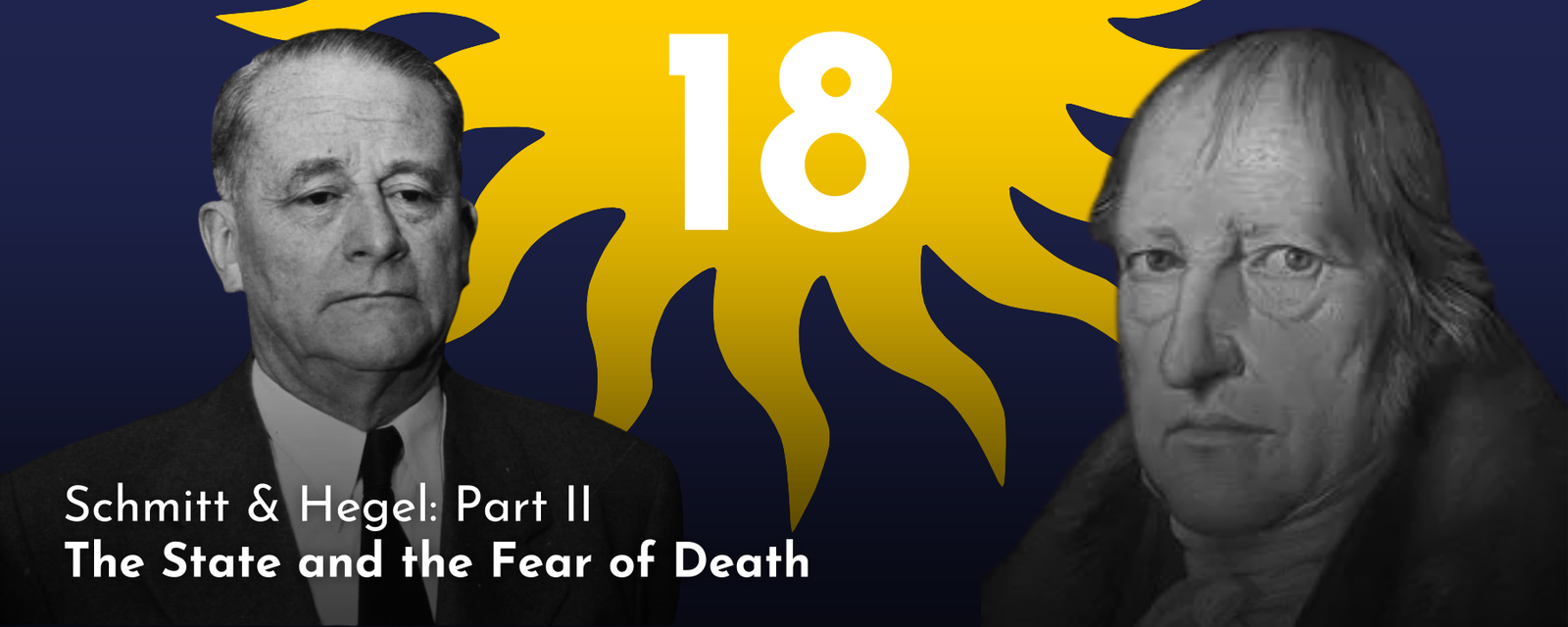
Schmitt and Hegel Part II: The State and the Fear of Death
“Freedom has to be struggled for; merely to assert that one is free is not enough. At this juncture man only displays his capacity for it in that he brings himself, as he brings others, into peril of death.” - G. W. F. Hegel, Lectures on the Philosophy of Subjective Spirit
Introduction
“Schmitt was no Hegelian,” says Henning Ottmann in his 1993 essay Hegel und Carl Schmitt (Ottmann 1993: 240). This doesn’t stop Carl Schmitt from describing Georg Wilhelm Friedrich Hegel as “the great Swabian,” “the great sociologist,” “the greatest German state philosopher” or just “the philosopher” (Mehring 1989: 19). In Political Romanticism (1919), Hegel was still the enemy; he’s blamed for “synthesising humanity and history,” which supposedly led to Marxism. Schmitt does not discuss Hegel’s view of the state or sovereignty in Political Theology (1922) [1]. Lorenz von Stein, a right-Hegelian who does a good job of reproducing Hegel’s organic view of the state, is mentioned yet hand-waved away in the same breath (Schmitt 2021: 64–65).
Then, Schmitt was slowly moving towards Hegel over the decades, starting in 1932 with The Concept of the Political, where Hegel is mentioned positively. Schmitt cites Hegel’s early work Die Verfassung Deutschlands (1799–1802), which Hegel wrote before his first major work Phenomenology of Spirit, and describes it as a “highly gifted work of his youth” (Schmitt 1932: 49). By 1934, Schmitt would abandon “pure decisionism” in favour of concrete-order thinking, with explicit recourse to Hegel.[2] He even laments that Hegel’s spirit did not stay in Berlin for long, chased away by Schopenhauer’s laughter (Mehring 1989: 107 n. 13) and that his spirit then wandered, via Karl Marx and Vladimir Lenin, to Moscow (Schmitt 1932: 50).
Why the fascination with Hegel? Perhaps it’s their common belief that the state is more than its constituent individuals, more than the sum of its parts, and more than mere law. Schmitt sees aspects of himself within Hegel’s work, the man who is said to have called the state “the march of God in the world.” and kept referencing it. [3]
However, Schmitt always put his emphasis on the existential nature of political struggle, which, according to Ottmann, Hegel did not. He says Schmitt only knows abstract negation, while Hegel’s negation is determinate – that this negation has content and is informative (Ottmann 1993: 240). Friend and enemy first, the state second.
This essay’s claim is that Hegel’s organic view on the life of the state contains Schmitt’s existential enmity in embryonic form, which we will unveil with his help. Schmitt may not have been a Hegelian, and Hegel may not have been Schmittian, but this essay will make the case that a position combining insights from both is possible, as they have more in common than divides them. Finally, we will offer a model of enmity that combines Schmitt’s gradual enmity (from Part I) with Hegel’s “Logic” of life.
In 1955, Schmitt had a vivid correspondence with Alexandre Kojève, the French superstar philosopher of the time. Kojève built his career around Hegel’s master-slave dialectic which can be found in his Phenomenology of Spirit. Naturally, he was of interest to the “Hegel fan” Schmitt (Mehring 1989: 105).
One letter reads (Schmitt & Kojève 2001: 105):
“Dear Mr. Kojève,
In my booklet Ex Captivitate Salus on page 89/90 in a remark about the ‘enemy,’ a verse (from Theodor Däubler) is quoted: ‘The enemy is our own question in form.’ To this verse, a gifted young German who was at Harvard for three years, said to me recently: The USA has no enemy because it has no form [Gestalt]. An important problem. [...]
It is generally as with the question of the possibility of a ‘dictatorship’ in the system of Hegelian philosophy the question whether there can be an ‘enemy’ in Hegel at all. For: either he is only a necessary passing stage of negation, or invalid and insubstantial. Of the animal functions, it means (p. 168) that they would be ‘something which is invalid in and for itself.’
I would be sincerely grateful for a line on this theme, while I am not impatient, for I know that you are occupied with much work.
Faithfully
CS”
The interest here is in Hegel’s enemy. Schmitt asks Kojève if Hegel’s enemy is a mere “passing stage of negation” or if he has an “enemy” similar to Schmitt’s view – that is, “our own question as form,” an existential element of our own existence.
But what is puzzling about this is that Schmitt had already answered his own question. The Concept of the Political already contains a footnote in which Schmitt praises Hegel’s definition of the enemy! There, he cites Hegel’s early System der Sittlichkeit (1802) approvingly. In the original, Hegel says:
“But that which is to be negated must itself be a living totality; the Ethical must, in its difference, contemplate its own vitality – and here in such a way that the essence of this opposing living entity is posited as something alien [fremd] and to be negated; […] Such a difference is the enemy” (GW 5, 329.15–20).[4]
The enemy is therefore a living entity, opposed and negated by another living entity, an “alien,” i.e. a stranger. Schmitt’s own definition sounds similar: the political order has to decide “… whether, in the concrete conflict at hand, the otherness of the alien [Fremde] means the negation of one’s own kind of existence and is therefore warded off or fought, in order to preserve one’s own, existential way of life” (Schmitt 1932: 15). The symmetry between the parties to the conflict is also maintained by Schmitt, who says that “the enemy is simply a possible combative totality of humans, facing another totality of the same kind” (Schmitt 1932: 16). A state which renounces the possibility of declaring the enemy ceases to be a political grouping. Compare this to Hegel, who, in his unpublished critical Jena writings of 1801, says that the defence of property against an external or internal enemy is how a political group is constituted (GW 5, 66.14–68.03). Schmitt even relates Hegel’s concept of quantity transforming into quality to his own concept of enmity (Schmitt 1932: 49), as explored in Part I. Once enmity between two groups reaches a certain level of dissociation, it changes in quality; enmity turns into the existential declaration of the public enemy, where the possibility of killing becomes acute. Schmitt goes as far as to claim that Hegel’s concept was always of political origin. [5]
Schmitt also thought that his own concept was dialectical in nature (Ottmann 1993: 235). Declaring the enemy simultaneously means the declaration of the friend, and vice versa. Friend and Enemy appear together by the same act.
How does Kojève answer Schmitt’s question? He follows Phenomenology of Spirit, specifically the chapter on the master-slave dialectic. He says: “Thus enmity is, after all, only a ‘moment’ of the ‘Logic,’ i.e. of human speech” (Schmitt and Kojève 2001: 107). Kojève also maintains that the enemy is “sublated,” i.e. simultaneously abolished and preserved, once he is recognised. This is a mistake. The existential essence in Hegel is minimised by making it a mere moment of speech; moreover, it does not follow Hegel’s Science of Logic. The Logic contains a chapter on Life as a logical concept – as the “immediate Idea” (more on that soon). Hegel is making a metaphysical argument about the structure of Life itself, mediated by Kant’s concept of “inner purposiveness.” Interpreting the Logic as mere human speech is incompatible with Hegel’s insistence that logical categories are also ontological categories. [6] Kojève himself acknowledges in a letter that he built his own personal Hegel out of the Phenomenology (Roth 1985: 299, Note 25).
Schmitt, meanwhile, invoked the Hegel that understood existential enmity as a necessity for the preservation of one’s own way of life. That is, the enemy as “our own question as form”; the presence of the enemy as an existential constant of human life. Even for the early Hegel, this enemy is “posited,” and not simply declared by human speech. So long as humanity as such does not have a common enemy, it can never be united (Schmitt 1932: 42). Enmity therefore constitutes a moment of human existence and organisation itself. For Kojève, the “fulfilled reason” of the “wise man” knows no enmity, something that can ultimately be overcome at the end of history (Schmitt and Kojève 2001: 107), an idea that is completely alien to Schmitt.
There is then an obvious difference between Schmitt and Kojève. Schmitt tries to find existential enmity in Hegel, finding its clearest expression only in Hegel’s early work. The answer to the question “who is the enemy?” is then the question: Kojève, is there an existential enemy in Hegel?
We can resolve it only by interpreting Hegel’s Logic as describing the logic of real things, with concepts genuinely present in the world. It is precisely this reading which Kojève resists that holds the key to understanding “Hegelian enmity”. Kojève’s answer in terms of “recognition”, on the other hand, is not wrong; and is precisely what Schmitt refuses to acknowledge, as he is sceptical of pluralism as such (especially in his 1938 booklet on Hobbes). Reconciling these two positions is the central theme of this essay.
The Logic of Life
Life acts to create more life. It is therefore a process whose goal is self-maintenance. According to Hegel, this creates an absolute contradiction, one that cannot be grasped by ordinary understanding or common sense. Hegel says that Life is the immediate Idea, and the Idea contains two things: a) the Concept and b) its corresponding Reality. Life is Oneness (= Einfachheit), the individual or the soul, maintaining itself as Form within something external, the body, which is a multiplicity of countless molecules. A living individual is therefore objective material pressed into a form, but this objective form is identical with a Concept from which it is nonetheless distinct (GW 12, 187.25–27).
The Concept of Life can be thought of as something like the code within DNA. Your DNA contains an image of who and what you are. It also knows which cell has to go where, which protein has to be produced when, while also creating a system that coordinates the parts into a Whole. If you cut yourself on a piece of paper, something knows that the cut violates the Concept. This makes the body produce new cells to fix the cut and restore the balance.

Most of the molecules in your body have been replaced many times over. Something puts the new molecules in their right place. Your body is made of a myriad of systems and parts. Each part needs to work together with the others in order to exist in the first place. Your lungs breathe to supply oxygen, your heart beats to pump it through the body, etc. The parts work together. This is what Hegel calls the Drive. The Drive is the Concept holding the parts of the body together in such a manner that they work together to produce Life. This is also what Hegelian ideality is, namely, parts having their reality only within a Whole, within its Concept. For, as Hegel says: “The Concept, which appears as subjective first, is the soul [Aristotelian soul, not the immortal soul] of life itself; it is the drive, which mediates its reality through objectivity” (GW 12, 180.20–22). [7]
If the Concept does not take care of its objectivity, the body cannot fulfil the task of self-maintenance. The body dies and returns to chemistry and mechanism, as Hegel says. It does not cease to be “Objectivity”, but it ceases to be ensouled; it stops being alive. The great contradiction of life is that life is simultaneously the chemical mechanisms and their movements and at the same time the ideality, the soul, that cannot be reduced to the physical movements.
We feel pain in order for our body to signal ‘to us’ that it is in danger and that something is wrong. Hegel thinks of pain in logical-philosophical terms. Pain is the moment when what the body is supposed to be and what it actually is come apart.[8] To “feel pain” is to feel yourself, your body, i.e. your Objectivity, your external existence, as not corresponding to how your Concept determines you to be. When the two come apart too much, we reach death.
Life feels the contradiction through pain and realises that it must pull the slipping Objectivity back into the Concept. This attempt to prevent the coming-apart of the Idea is what I call the Concept’s “fear of death,” analogous to the Drive. In Life, this can take the form of fever, regeneration, or simply physically moving away from pain. This is Hegelian Negativity: the Concept negates the independent existence of Objectivity, reforms it in its image, and by that movement returns it to the Concept.
Hegel explains much of this in the first section on the Idea in the Science of Logic. The analogy with the state explicit:
There is the Concept of the state, and there is a Reality that corresponds to it. If there is no correspondence between the two, it is as if the state has lost its soul. In life, the dead body returns to chemistry; in the dead state, its constituent parts return to individuality. Here, too, there is a drive within the state to prevent this, because, in Hegel’s view, just as the organs depend on the Concept, so do the parts or members of the state depend on the Whole (the Schmittian Friend). If they do not work together, they “must perish.”[9] Even the worst state, however, still remains an Idea as long as individuals continue to obey its Concept. A Concept with power to rule over Objectivity is what Hegel would later call sovereignty (GW 12, 175–176).
For Schmitt, the sovereign stands outside the lawful order while simultaneously being part of it (Schmitt 2021: 14). This is the logical structure of the Idea: the Concept determines the shape of its Objectivity, yet remains immanent to it. The sovereign must create the order from a position that is outside the order, while still binding itself to that order.
The contradiction is just as active within the state as it is within life itself. The state has its constituent parts (churches, bureaucracies, capitalists, individuals, etc.) while simultaneously being more than their accumulation. The state is an ideality. The “labour” of this ideality is to maintain itself through contradiction, to transcend the contradiction between Subjectivity and Objectivity is precisely its content (Philosophy of Right, §28).
Within the state, the “fear of death” is the fear of the state’s dissolution, the end of the political entity’s continuity. This very notion of fear is something that underpins the thought of another thinker who Schmitt greatly admired, namely, Thomas Hobbes. At the end of his Leviathan (1938), Schmitt praises Hobbes for highlighting the existential fear that grounds the state:
“Today, we understand the undiminished power of his polemical style, we appreciate the integrity of his thought, and we admire the unwavering spirit that fearlessly explored the existential anxieties of humanity [...]” (Schmitt 1995: 132).
We found the sedimented existential element.
The Logic of Recognition
The primary text in which the mature Hegel deals with the state in a systematic manner is the Philosophy of Right (1820, henceforth PR). In PR the constituent parts of the state are self-conscious groups and individuals who know themselves. This is what distinguishes the state from the body, wherein the cells are not self-conscious. [10] What animates the state is the mutual recognition between the universal will (the state) and individual, subjective wills. Or, as Hegel puts it in §206: “The recognition [...] shall at the same time be effected by the mediation of the arbitrary will.” [11] Hegel’s arbitrary will is what we call “free will” in common parlance. This free will must be mediated and made to recognise the will of the state as its own.
The state is therefore spiritual, not natural. That is, when Hegel calls the state organic, he is referring to its analogy to the logical structure of Life, not to any actual organic biological unity between its members. The state is one in spirit: its members recognise the state’s will as their own, and the state recognises its members as its own. We use the term “team spirit” in this manner. When Concept and Objectivity are coming apart in the state, we see the mutual withdrawal of recognition; the arbitrary wills no longer recognise the end of the universal (the state) as their own end. The Negativity of the state is therefore its ability to be recognised by its members precisely when it is negating their arbitrary wills for the sake of the Whole.
Spirit gains reality only through mutual recognition. It is here that Schmitt’s existentialism can add a dimension that is only implicit in Hegel. In the case of Life, the reparation of a wound is an automatic procedure that depends on Life’s own resources and structure. In the sphere of Spirit, “fixing” the “coming apart” of Concept and Objectivity is a matter of “repairing” recognition.
Let’s take the paradox of autonomy [12] as an example. A particularity within the state, say, Catalans in Spain, is concerned with whether their own individual will is truly recognised by Spain, and whether they can maintain themselves as a distinct group through the Spanish state. If they believe they cannot, they withdraw their recognition of the Spanish state as their universal and strive for independence. From the perspective of the Spanish state, this opens up a dilemma. The recognition of Catalan autonomy could either lead to finally gaining recognition from the Catalans and end separatism, or the Catalans could continue to feign recognition and seek independence regardless, while using the tools granted to them by Autonomy to further the separatist cause.
Here, recognition is their own question as form. Catalonia and the Catalan language can only exist if it is recognised as an autonomous region with its own language and customs by Spain. Spain’s sovereignty relies on it being recognised by other states and by its own constituents, including Catalonia. Because one’s own existence depends on the recognition by the other, it is existential. Both Spain and Catalonia fear “death.”
Hegel’s blind spot is that he only hints at the fact that recognition between groups is contingent and can therefore fail. As we will see later, Hegel does explain that some groups can withdraw recognition, and that without mutual recognition they develop enmity (the rabble, individuals in antiquity, or the conflict between divine and state law in Antigone). The fact that recognition rests on a groundless either-or decision is not explored in depth. The existential dimension is provided by Schmitt. The decision is underivable and therefore initially not fully rational. It starts as a bet because its rationality depends on another decision, which is itself dependent on how the other side believes one will decide. The state cannot know the consequences of its decision in advance, as it depends on another existential decision. Thus, there is an element that is beyond rationality.
The State
For Schmitt, the Political comes first, and the state is derivative as its highest expression. [13] The friend-enemy distinction itself determines the form of organisation. For Hegel, the state comes first, and politics are derivative. In Hegel, the state is an organism within which multiple elements exist. Like the Concept of Life, the state has its means as its own end; that is, its self-preservation of itself and its members constitutes the end of the state.
PR’s §269 defines the state as an organism, using the same terminology as in the analogy above and in his Concept of Life (Hegel makes this analogy multiple times in the PR, including in the lecture notes appended). The state is the “development of the Idea” into its inner distinctions (the different powers, such as the executive and judiciary, but also the family and civil society) as an objective actuality. These inner distinctions are determined by the Concept of the state. The Concept of Life here is not a mere metaphor for the state; it has a deeper logical affinity with it.
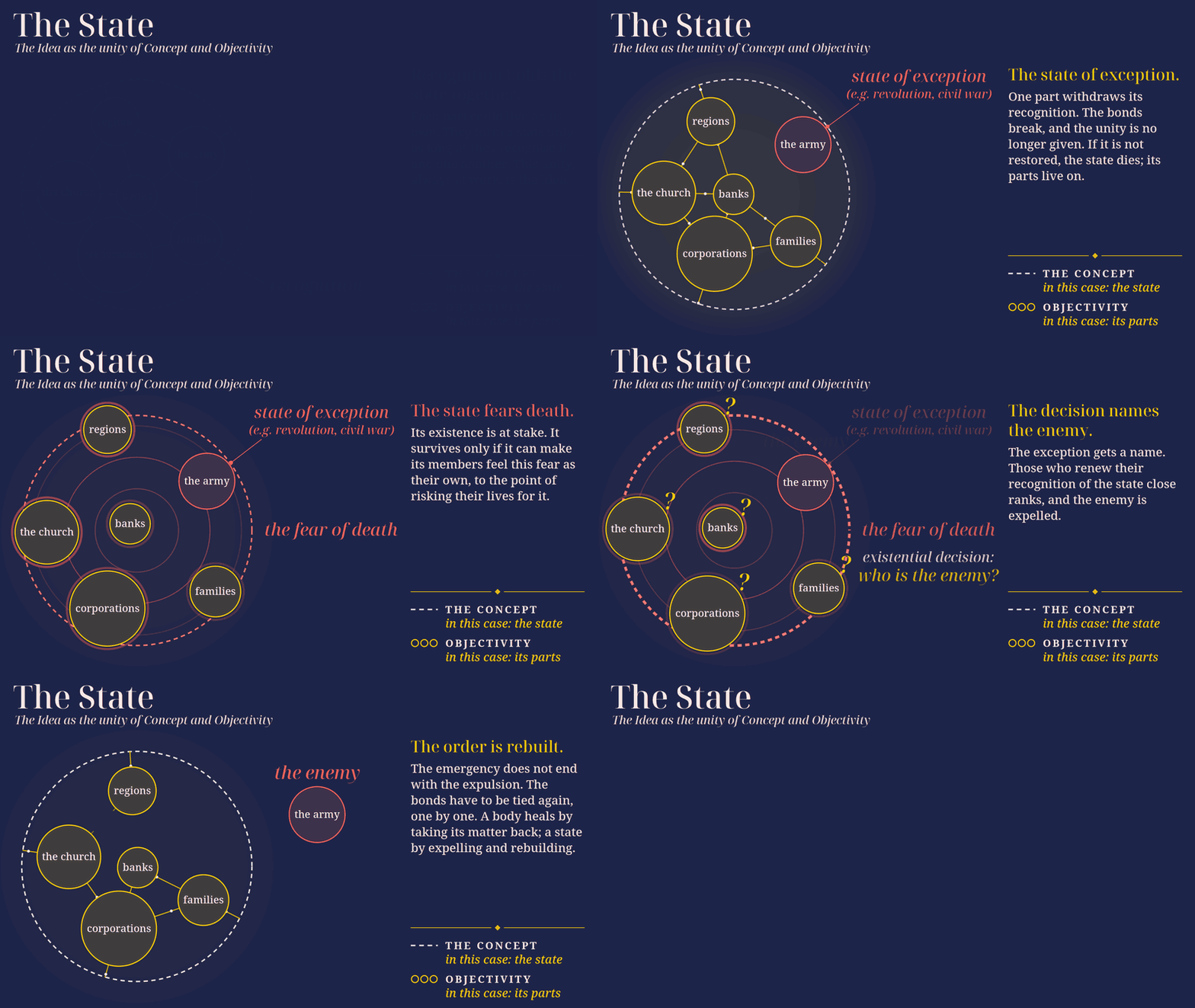
The state of exception is the moment when the state’s very existence is under threat (Schmitt 2021: 14). It is therefore analogous to extreme pain in the Concept of Life. The exception is the moment when the contradiction between the Concept and its Objectivity is felt most acutely, and when Negativity is most needed. The state is in danger, and its members could slip away. According to Schmitt, in the state of exception, law is suspended while the existence of the state itself is maintained. The exception is thus the moment when the enemy must be fought for the sake of existential self-preservation. Hegel, too, saw this and expressed it in his own language. In the PR (Remark to §278) Hegel says:
“In a situation of acute danger, whether internal or external, it is sovereignty which pulls into its simple concept the existing organism [...] together and [sovereignty] is then tasked with the rescue of the state, while sacrificing what is normally rightful. Thus, ideality comes into its proper actuality.” [14]
This is Schmitt’s conception of sovereignty in Hegel, coupled with a hint of the friend-enemy distinction: the Whole is the friend, within which everyone works together to reproduce themselves, and the enemy is whatever threatens it. The emergency also tests whether the members of the state recognise the universal will as their own (the definition of ethical life (§§142, 147)). If, in an organism, health consists in the different parts working together smoothly as an expression of its Drive, then the Drive of the state is patriotism. In §268, Hegel defines patriotism as the result of the habitual “willing of the state” on the part of its members. It is the consciousness that one’s own substantial and particular interests are also in the interest of the state. Patriotism is developed during normalcy, but in the state of exception, when choices open themselves up, the depth of that patriotism is truly revealed.
Schmitt, in any case, did not think it was possible to make people sacrifice themselves for mere liberal individualism (Schmitt 1932: 57). A state survives when its members see the Whole as their own. When Francisco Franco launched his coup in 1936, the rebels were the Spanish Republic’s “own question as form.” It was a challenge to whether the Republic still represented the universal will or not. For each side, the other was the ultimate existential enemy, with whom no reconciliation was possible. Every city, every brigade, every police department faced an existential choice and had to ask itself its own question as form: which of these two sides represents my will, and which is my enemy?
For Schmitt, the sovereign is whoever can decide on the state of exception, and the sovereign’s decision is an absolute decision, “made out of nothing,” like the miracle of theology (Schmitt 2021: 69). This is much like Hegel’s view of the sovereign as someone who pulls particularity together into a whole in the state of exception. [15] It is only in Hegel’s modernity that the final decision comes to be definitely associated with the monarch (today we would say the head of the state) instead of God.
Hegel says in §278 that the unity of the state is rooted in a simple Self – the sovereignty of the state. Going further, §279 defines sovereignty as groundless self-determination of the free will.[16] This is also how Schmitt describes the sovereign decision as “coming out of nothing,” but with one important difference. It is groundless self-determination only insofar as it is abstract. The sovereign makes the “last” decision of the state.[17] This decision stems from the substantial unity of the state and stands at the end of its process of self-preservation. Hegel goes so far as to say that the constitution of a state should not be seen as having been “made” at all (Remark to §273), i.e. he wants the sovereign’s last decision to be as immanent as possible. Its historical origin should be irrelevant. For Schmitt, however, the decision is the basis of the order itself and determines it ex nihilo, even if not in the literal sense as explored in Part I. The difference is slight, but exists: Schmitt emphasises that the sovereign is outside the order, while Hegel insists that even if the sovereign is outside the order, it is at the same time fully within it.
It is in the Phenomenology of Spirit that we find the clearest description of this mechanism. Spirit, that is the state, is the Oneness (= Einfachheit), the negative unity of different systems and parts such as families or institutions, which would otherwise isolate themselves. In order to prevent their isolation, and by extension the death of the state and the disintegration of the Whole, the government should periodically “unsettle” them through war. Hegel thinks the state should violate its own order and make the parts that are becoming independent feel their master, death. Spirit (the state) therefore prevents dissolution into natural existence and elevates its Self into freedom. The negative essence of the Whole (the power to negate individuals) is the actual and the power of its self-preservation (loose paraphrase from GW 9, 246). [18]
The dissolution of the state is the existential fear that Schmitt praised Hobbes for having highlighted, while the state of disorder Hegel wants to prevent is Schmitt’s “Behemoth” against which the Leviathan was chosen to fight (Mehring 1989: 67). In the state, self-preservation is a matter of existential decision rather than something automatic, as in nature. The members must be made to fear death by a sovereign who senses the danger to the state and recognises that its own reproduction is at risk. Only then do the parts recognise their dependence on the state. The state therefore preserves itself through the very moment in which it suspends its own laws and structures for its own sake.
Hegelian Pluralism and Enmity
How does the state die? Through its individual members and parts slipping away and becoming independent. The state dies when the Concept loses its negative power. Individuals no longer maintain themselves through the state, for they have withdrawn their recognition and, through the withdrawal, become foreign elements within it. §278 makes this explicit: “the idealism, that makes the sovereignty, is the same determination according to which in the animal organism the so-called ‘parts’ are not parts at all, but limbs; they are organic moments, and their isolation and existence for-itself is a sickness.”[19]
The sickness of both the state and the organism consists in a moment that isolates or fixes itself against the Whole. The internal enemy is existence for-itself. Cancer will be my analogy: a cell that fixes itself against the Whole and starts to expand using resources otherwise meant for the body itself. The cancer cell is not necessarily trying to kill the body per se, but simply by becoming an independent, self-organising system within it, it becomes a threat. The analogy with Life is at least present in Schmitt’s work. He defines the “enemy” as “negating his opponent’s way of life” in order to preserve its own form of existence (Schmitt 1932: 15). The “enemy” within the state emerges from a similar logical problem as the enemy within the organism, but at the level of Spirit, or recognition. The “element that fixes itself against the Whole”, the potential enemy, is not just a metaphor. Hegel names two examples.
1. §206. Here, Hegel contrasts the modern world, with its division into state, family, and civil society, with the polities of antiquity. Throughout the PR he repeatedly stresses the importance of “subjective particularity” to modernity. Modernity is characterised precisely by giving subjective particularity and individualism their proper place and recognising them. He criticises Plato’s Republic for dismissing the subjective element entirely. For instance, in the Republic no one is allowed to choose their own profession. In §206, the point is that the ancient states were not reconciled with subjective particularity. Even when unrecognised by the state, however, subjective particularity exists as an essential moment and often appears in the form of enmity against the Whole. It becomes the “ruin of the societal order,”[20] seeking to overthrow it.
2. The rabble. The rabble is a concept developed by Hegel in §§243–246. Here he states that in “bourgeois society” (= capitalism), luxury and great wealth are created on the one side and great poverty on the other. The result is the emergence of a class of people that is unable to produce its own subsistence through work. Hegel thinks that the problem here is not poverty itself, but rather that participation in civil society is defined by the ability to serve the universal interest through useful work and then to be rewarded sufficiently to sustain oneself. Therefore, if an individual is unable to do this, they cannot experience civil society as serving their own needs and interests. Their own life is not guaranteed by the system of needs (Hegel’s term for the mutual interdependence of actors on the market). As the state is supposed to guarantee their existence, the failure to do so produces contempt. The individual does not see the state’s interest as their own because their life is not reproduced through the state by their own means. The rabble withdraws recognition of the state because its own particular will is not fulfilled by it.
It is important to note here that Hegel is not looking for a perfectly homogeneous state with zero internal difference. In fact, the opposite is true. Hegel makes the state’s ability to tolerate difference dependent on its own strength. A strong state can allow independence – as in the case of the Quakers – and engage in specific negotiations with these groups, such as granting military exemption (§270, footnote). It can also grant recognition to and integrate a foreign element, such as the Jews.
Because persons are only persons so long as they are socially recognised, and because we all depend on society to reproduce ourselves and survive, when one is not recognised as a person by the state, one needs an alternative universal will. This “alternative will” must also organise itself into a “quasi-state” in order to survive. Those who are not recognised by the state must create communities or groupings that support one another. European Jews are a good example. They had/have strict endogamy, a Europe-wide network of communication, schools, and solidarity among members. These communities, however, often become the targets of great enmity, growing out of difference.
There is a dialectic at play here. Exclusion, or mere existence of difference, necessarily creates the conditions for independent self-organisation by those excluded, which then reinforces the difference and exclusion. But it is this contradiction that the state must hold together. It must include difference without drifting into cosmopolitanism, by insisting on the unity of universal and particular through the state. Mere difference, like that of the Jewish community in relation to other communities, is often falsely interpreted as an existential threat, while genuine threats go unrecognised for a long time. That which remains outside of the Whole is simply often seen as siding with the enemy (Schmitt 1932: 40). The possibility of killing emerges at the extreme end of enmity, when the state believes it has become necessary to fight the enemy by all means in order to defend the Whole out of self-preservation. In fact, Hegel defines the state in §260 in the following manner:
“The principle of the modern state has its monstrous strength and depth in its ability to allow the principle of subjectivity to develop itself to its self-sufficient extreme of personal particularity, while at the same time having the ability to pull it back into substantial unity and to maintain itself through it.”[21]
Or in other words: The more contradictory the state is, the stronger the state. That is Hegel’s strange conception of the state. The freer the people are, and the more willing to die for the state, the better. In fact, the willingness of individuals to die for the state is the very expression of their own freedom (§328). This is because Hegel’s concept of the state is split into the familiar Hegelian triad of family, civil society, state. The family and civil society are each individual moments with the highest possible independence and dignity, with civil society itself split into corporations and markets.
Schmittian Monism
And it is precisely here that Hegel and Schmitt cannot be fully reconciled, and why our model is our own. Schmitt is an enemy of pluralism. In Leviathan, Schmitt praises Hobbes for his “total” vision of the state, because it stands opposed to indirect power. For Schmitt, “the modern state apparatus requires a unified will and a unified spirit.”
The individual subjectivity that Hegel makes the core principle of the modern state is exactly what, for Schmitt, destroyed Hobbes’s Leviathan. As he puts it: “When multiple, quarrelling spirits move this apparatus from obscurity, the machine [Hobbes’s Leviathan] breaks and with it the system of the rule of law” (Schmitt 1995: 118). It is “party pluralism” that has destroyed the liberal state. For Schmitt, command and power must always be public and visible; the enemy must be declared. He therefore opposes the Scottish Presbyterian Church, Freemasons, trade unions, and, yes, the Jews, especially when they are assimilated (Schmitt 1995: 106),[22] fearing the “masks” they put on to further their own interests within obscurity.
For Schmitt, the purpose of the Leviathan – the state and order – is to defeat the Behemoth, the revolution, the equivalent to Hegel’s warning against the state returning to individuality. Since Schmitt is sceptical of reconciliation of differences, he places the emphasis on coherence and homogeneity. The state must be one; difference must be minimised and institutions subjugated to the sovereign. Ottmann (1993: 236) also makes this exact point. Hegel, by contrast, has both moments: liberal individualism and the total power of the sovereign.
The difference between them can be seen in how they view the United States. For Hegel, the US represented the future. He predicted that the world spirit would move to the Western Hemisphere; we can assume with optimism, considering the world spirit is the expression of the most rational for Hegel. For Schmitt, the United States embodied economic imperialism. Far from praising the marvels of modern capitalism, as Hegel did, Schmitt lamented modern “value-thinking” which was preoccupied with calculation and comparison (Mehring 1989: 63). We can assume that both thinkers would consider their views vindicated by the modern United States. Hegel, because the most powerful nation in the world is still the one that grants “the most” individuality. Schmitt, because American polarisation is reaching new heights, with internal differences making the country harder to govern and pushing it towards caesarism. Schmitt’s letter to Kojève even takes seriously the idea that America has “no form” and thus can have no “enemy.” For Schmitt, a society as pluralistic as the US cannot truly be “an entity.” For Hegel, whether it is an entity is decided in the state of exception, when the sovereign’s ability to pull the state together reveals itself.
The Graduality of Enmity
From the existentially enriched Hegel, I propose a model of enmity built around the transmutation of quantity into quality, with the final quality being Schmitt’s existential, ungrounded decision. The levels are:
a) Pure difference. This is a group, such as a religious or ethnic group, that has its own laws and customs distinct from the state, but without the ability to threaten the Whole. The Quakers or Jews fall into this category (§270). Ideally, groups like these are self-maintaining while still contributing positively to the Whole. But, as Difference, the possibility of escalation still exists. Recognition of difference goes both ways. The state can recognise an element as part of itself and not receive recognition in return, such as France banning ethnic census and yet it is still the norm to see individuals of migrant origin only sport the flag of their home country in public or on the internet. Or it can recognise an element and successfully receive recognition in turn (Ferdinand Lassalle was a Jew who became a passionate Prussian patriot). Schmitt himself is sceptical even at this level and wants to minimise difference due to its potential to escalate.
b) Residue. This is the rabble. The rabble is outside the order of the state while being produced by its civil society. They are within the state but no longer reproduce themselves through civil society. This makes them indignant towards it, because they have expectations about what civil society is supposed to provide for them, but those expectations are not met (§§243–246).
c) Rival order, which is equivalent to early-stage cancer within an organism, an element within the order that becomes for itself. This is what §206 describes: an internal subjective element that fixes itself against the Whole. In short, it is a rival principle. A more explicit example would be the passage on the Antigone in the Phenomenology of Spirit, which concerns the conflict between divine law and state law. Another example would be the Italian mafia. According to Gans, Hegel mentioned the Neapolitan Lazzaroni as an example of the rabble in his lectures (Zusatz to §244). These would later organise themselves into the Camorra – an enemy, but not yet an existential one. This is also Hegel’s “sickness,” which he takes from the organism.
d) Existential enemy. This is the moment when quantity turns into quality. The enemy is now an existential threat to the state and threatens to cause its dissolution. This is the state of exception, when Concept and Objectivity are strained and could come apart. Here the state must suspend public order in order to save itself. Examples would include modern total wars, but also civil wars such as the Spanish or Russian Civil Wars. As an existential enemy can only be determined by another existence through decision, the final step from c) to d) cannot be derived, even if, in the Hegelian view, it is grounded in the life of the state. Sometimes, the final decision is wrong, and the rival order is imagined, like National Socialist Germany declaring the Jews its existential enemy, or Stalin starving millions in order to get rid of the kulaks. Sometimes, enemies are correctly identified, like the Union recognising the Confederacy (and vice versa) as an existential enemy. Determining how an existential enemy is declared and under which conditions it would be correct goes beyond the scope of this essay. This is the most Schmittian step, but it is also present in the young Hegel whom Schmitt cited, in the Phenomenology and in the paragraphs on War in the PR.
Since this is the realm of the spirit, the grades of enmity operate through recognition, not pain. The recognition of difference; withdrawal of recognition in the residue; withdrawal of recognition by the state or of the state by the rival order; and, at last, the sovereign’s decision to recognise the existential public enemy to whom all members of the state must commit themselves.
Conclusion
Finally, this gives us the following model of the Hegel-Schmitt reconciliation. We added recognition of difference to Schmitt, but made the recognition an existential, underivable decision.
If we take Hegel seriously, and see his Logic as doubling for an ontology of the structure of the world, including if we take contradiction seriously as a fact of the world rather than speech, a large world opens itself up on how to use Hegelian Logic sociologically. This essay was an attempt to expand on Schmitt’s concept of the state through precisely this Hegelian logic: recognising the inherent contradiction in how sovereignty expresses itself or how the state is its parts that are simultaneously not itself and so on. We believe this model of existential gradual enmity can be a useful sociological lens to explain actual empirical historical situations, which we will attempt to do in Part III.
The strength of the state shows itself in the extent to which it is able to tolerate differentiation within itself and fight only those enemies that genuinely threaten it.
Politically, we are committed to the idea that declaring the public enemy must come with the greatest possible responsibility. While it can never be cleanly derived, it must nonetheless be at least informed and result from the “discussions” the Hegelian monarch ends through his decision. We are, however, also committed to the vision that declaring the enemy can be necessary and thus existential. It naturally follows that true public “enemies” are never enemies for their moral qualities, but for the existential threat they pose. Scepticism towards “ideals” and “normativity” is likewise something both Schmitt and Hegel share.
It is difference itself that always carries the possibility of escalating into existential enmity. The enemy we choose is an answer to the question of who we are. This is what disturbed Carl Schmitt throughout his life.

Octavian
Main WriterAve Europa Germany