The Measure of Life: Being and Becoming
What time is it? Do you have time? Is there still time? We have plenty of time. We did not have enough time. These everyday expressions reveal a fundamental truth about human existence: time is not merely something we measure, but something we experience, struggle with, and strive to give meaning to. We have all, at some point, felt the anxiety of not having enough time. For some, this feeling is almost constant; for others, the very idea of lacking time seems absurd, as though those who complain of a lack of it have nothing but time to spare. But how can time be experienced so differently? And what does this tell us about our relationship with it?
Phenomenologically, time is inseparable from consciousness and, more specifically, from the changing states through which consciousness encounters the world. It is through our experience of time that life acquires immediacy, that possibilities become actual, and that existence unfolds as something more than a sequence of events. But our experience of time does not necessarily correspond to how we use it. The man who feels constantly pressed for time and the man who seems to possess an abundance of it may be equally estranged from their own needs. Neither inhabits time in a manner proportionate to what they have or what they require. Without a conscious organisation of time, both body and mind risk operating on autopilot: repeating habits, fulfilling expectations, and responding to circumstances without ever fully appropriating their own existence. The individual becomes a function of appearances and routines, lacking a sufficiently reflective relationship to the self. This is the NPC – someone who appears to participate in life without seeming to exercise meaningful agency over it.
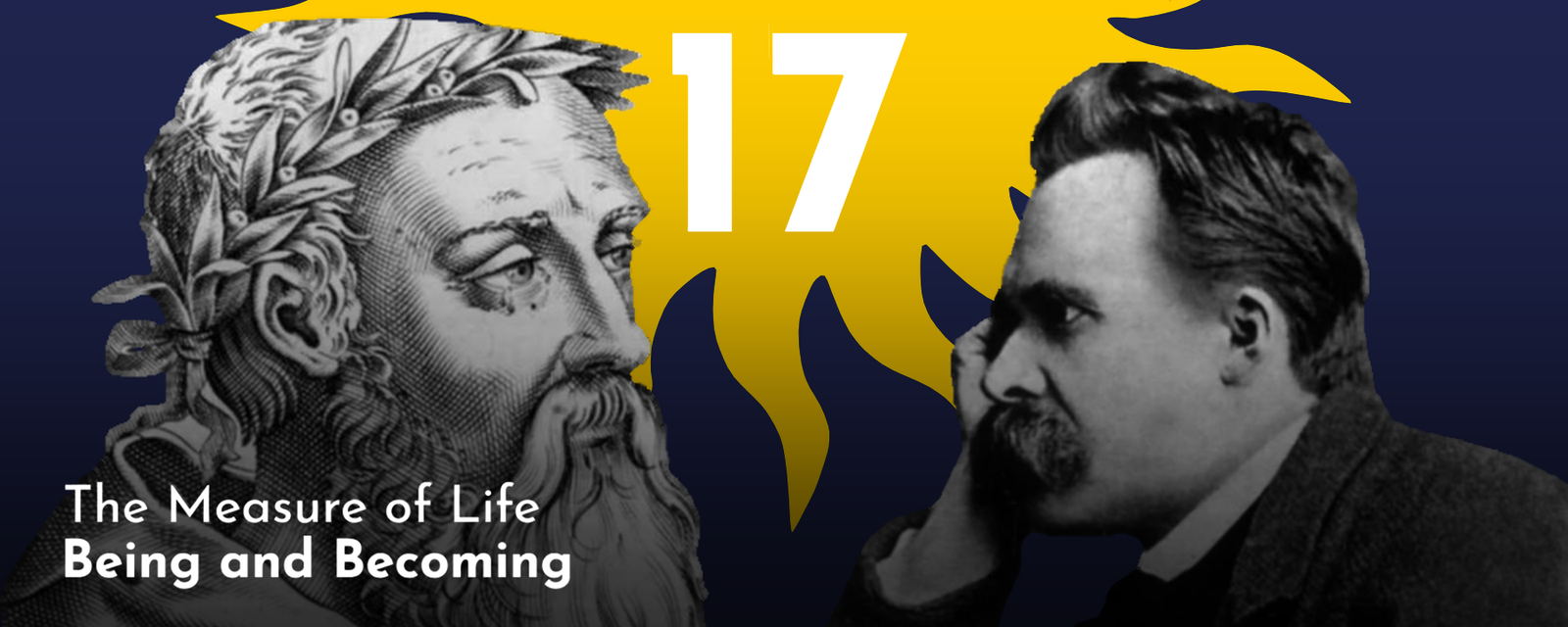
But what distinguishes the NPC from the individual who possesses an “essence” of their own? And how should we understand the relationship between identity, continuity, and change? We tend to think of continuity and change as opposites. We assume that remaining the same means resisting the passage of time, while changing means risking ceasing to be what we are. But this opposition is more apparent than real. Heraclitus offers one way to overcome this split. In his famous fragment (B12) concerning the river, he writes: “On those stepping into rivers staying the same other and other waters flow.” A shallow interpretation of Heraclitus portrays him as the philosopher of “perpetual flux,” as though his thought reduced reality to an uninterrupted process of becoming in which nothing remains stable enough to be truly known. This interpretation comes partially from Aristotle, who in several sections of the Metaphysics states that those of “Heraclitean opinions” held everything to be in such a radical state of flux that nothing could truly be known. It is, however, quite clear that this is not the case in the river fragment. The river remains the same river precisely because its waters continually flow and give way to others. Its identity does not depend upon the preservation of an unchanging substance, but upon the persistence of a pattern or a set of properties: a bed, a course, a direction. What endures does so not in spite of change, but through it. Identity, then, is not simply what survives the passage of time; it is also what time, through change, continually sustains.
The same is true of the self and of our relationships with others. We rarely perceive these transformations as they unfold. Usually we do not experience ourselves changing in real time; instead, we discover that we have changed retrospectively, when a once convincing belief no longer holds the same force, or when a friend no longer seems to recognise the person we have become. The transformation often precedes our awareness of it. Nor can dissolution and renewal be neatly separated, as though we must first abandon one identity before constructing or taking on another. A belief persists only insofar as it is continually reaffirmed, reconsidered, or reinhabited. Even when we remain faithful to it, our relationship to that belief changes with the circumstances through which we understand it. Continuity is therefore never merely the absence of transformation; it is a form of transformation in its own right.
This also complicates our understanding of the self. Because we often recognise change only after it has come to pass, the person we take ourselves to be is never entirely identical to the person we are in the present. Our self-understanding is, to some extent, retrospective: a reconstruction assembled from memories, commitments, experiences, and interpretations of what has already passed. We tell ourselves who we are by giving continuity to a life that, as we live it, is never quite as coherent as the story we tell. The self is not simply discovered as a finished object within the flow of time; it is also constituted through the interpretations by which we make sense of that flow.
But if the meaning of change becomes apparent only in retrospect, what remains of our capacity to decide in the present? Perhaps the significance of our decisions lies precisely in the moment when a transformation becomes visible to us – a moment of existential tension. We cannot decide whether to undergo a change that has already taken place, nor can we simply will ourselves back into the person we once were. We can, however, decide how to respond to the distance between who we were and who we have become: whether to acknowledge the emerging shape of our lives or to continue defending an identity that no longer quite fits. Yet neither response is inherently good or virtuous. To hold on may be an act of fidelity to something worth preserving, but it can also be a refusal to recognise what has changed. To embrace change may express a willingness to “become more fully oneself,” but it may equally reflect a readiness to discard what deserves to endure.
In either case, our response does more than determine the direction in which we move. It also reshapes our relationship with the past. What we choose to preserve, what we allow ourselves to relinquish, and what we reinterpret all contribute to the meaning we assign to the person we once were. We do not simply inherit our past; we continually decide what place it will occupy in the present. Perhaps, then, the question is not whether we can remain the same or must inevitably change, but whether we can become conscious participants in the process by which continuity and change constitute us. To live deliberately is not to escape the flow of time, but to recognise our place within it – to understand that we are neither entirely free to determine what we become nor merely passive recipients of what happens to us. We are, rather, beings whose identities emerge through time and whose freedom consists, in part, in how consciously we respond to that emergence.
Ultimately, life is not merely an object that we observe, define, or explain. Life is a condition that we inhabit and experience from within. To understand life solely through an external definition is to abstract it from the very existence that gives it meaning. Biology can define the conditions under which an organism is considered alive, but such a definition cannot by itself account for what it means to live as a human being. Human existence exceeds the conditions of its biological possibility. It encompasses the ways in which life is interpreted, valued, and actualised by those who live it. To speak of life, in the existential sense, is therefore to speak not only of what it is but also of what it might become.
Let’s take Nietzsche as an example. The distinction between the higher and the lower, the master and the slave, and the Übermensch and the last man reflect different ways of affirming and actualising life. These are not simply different kinds of people, but different orientations toward existence, different ways of organising one’s values and determining what is worth pursuing. All are manifestations of life, but they do not relate to life in the same way. What distinguishes them is not merely what they possess, what they accomplish, or how long they live, but the horizon within which their existence acquires meaning.
Of course, the question of what constitutes a good life cannot be detached from the concrete group or individual who lives it. Our notions of the good and the bad, the desirable and undesirable, emerge within particular historical, cultural, and social conditions. There is no escaping the fact that we evaluate life from within life itself. But this does not mean that all possible forms of existence are equal, nor that the question of how one ought to live dissolves into a matter of personal taste. Rather, it means that any evaluation of life necessarily involves a conflict between different values, competing interpretations of existence, and competing conceptions of what actually deserves to endure. The question is not simply whether one lives, but what one lives for.
Different forms of life are distinguished, in part, by the temporal horizons through which they understand themselves. Some remain almost entirely shackled to the immediate present, measuring existence through pleasure, comfort, and satisfaction. Others understand the present in relation to something that precedes and exceeds it: a people, a culture, a body of work, a commitment, or an ideal whose significance is not exhausted by the lifetime of the individual who serves it. The difference between the two lies in the latter’s capacity to recognise something as worthy of preservation, cultivation, or sacrifice beyond the immediate demands of the self.
The last man, as Nietzsche presents him in Thus Spoke Zarathustra, is said to have invented happiness. He has reduced the demands of existence to comfort, security, and modest satisfaction. He seeks to eliminate the very tensions through which human beings might overcome themselves. Nothing should hurt too much, nothing should demand too much, and nothing should disturb the equilibrium of a life organised around its own preservation. The horizon of the last man is narrow because he struggles to conceive of anything that might justify living otherwise. He blinks, as Nietzsche writes in the prologue (§5), having mistaken the absence of existential risk for the fulfilment of existence today.
The higher man, by contrast, is oriented towards something that exceeds immediate satisfaction. He may devote himself to a work that will outlive him, defend a tradition he did not create, or accept suffering for the sake of a commitment whose value cannot be reduced to his own comfort. Where the last man asks how life can be made safer and more “agreeable,” the higher man asks what life might demand of him. His temporal horizon extends beyond the limits of his biological existence, not because he can escape death, but because he can recognise values whose meaning death does not exhaust. His life acquires direction and meaning through the possibility that something may endure beyond him.
This distinction between the two becomes even clearer when we take into account what a person is willing to exchange for immediate gratification. One may surrender one’s convictions, one’s cultural inheritance, or even one’s sense of belonging for a fleeting pleasure. There is, of course, nothing inherently wrong about enjoying food, sport, or entertainment. It becomes a problem when consumption stops being one element of life and instead becomes its organising principle – when everything is evaluated according to the satisfaction it provides in the moment, and nothing is allowed to make a claim upon us that extends beyond that moment. The issue is not pleasure itself, but the hierarchy of values within which pleasure becomes sovereign. What is surrendered is the possibility of a life organised around something more enduring than consumption.
A life devoted exclusively to preserving itself can succeed in prolonging its own existence while losing sight of what makes that existence worth affirming. Conversely, a life directed towards something greater than its immediate interests may accept uncertainty, hardship, and even the possibility of death without regarding them as sufficient reasons to abandon its commitments. This does not mean that death is in some way inherently noble, that suffering is inherently meaningful, or that the willingness to sacrifice oneself guarantees the worth of what one serves. Sacrifice can be an expression of strength, but it can also stem from resentment, fanaticism, or submission. The willingness to die for something is not, by itself, proof that the thing is worth dying for. What matters is the value being affirmed and the kind of life that value makes possible.
This brings us to a final question concerning time and existence. If our identity is sustained through change, and if the meaning of our lives emerges through the values by which we organise that change, then how we inhabit time is inseparable from what we become. The present is never just a point to be consumed and left behind. It is the site at which we either reaffirm or abandon the commitments that give continuity to our existence. Every decision participates in the formation of a self whose significance can extend beyond the immediate circumstances in which that decision is made. We are not simply given a life and then asked how long we can preserve it. We are continually confronted with the question of what kind of life we are making through the ways in which we spend, direct, and understand our time.
The last man claims to have invented happiness and blinks. The higher man confronts the uncertainty of existence without demanding that life first guarantee him comfort. The difference is not simply that one lives for the present while the other lives for the future. It is that the former seeks to make existence answerable to his immediate satisfaction by bringing everything down to his level, whereas the latter is prepared to make his immediate satisfaction answerable to something he considers worthy of affirming. One asks how life can be made to serve him; the other asks what he might serve without thereby surrendering the capacity to “become himself.”
Perhaps this is where the question ultimately leads us. To live consciously is not merely to manage the hours available to us, nor even to recognise that we are changing. It is to become aware of the values through which our time acquires direction, and of the kind of person those values are making of us. We cannot prevent time from passing, nor can we preserve an identity untouched by its passage. What remains within our power – even if imperfectly – is how we respond to the transformation through which we become who we are. The question is not simply whether we have enough time, but whether the life we are making of it is worthy of the time we have. In this sense, we might recall Nietzsche’s formulation in The Will to Power (§617): “To impress upon becoming the character of being – this is the highest expression of the will to power.” May the good European always embody that which endures.
Lucas
FounderAve Europa Finland