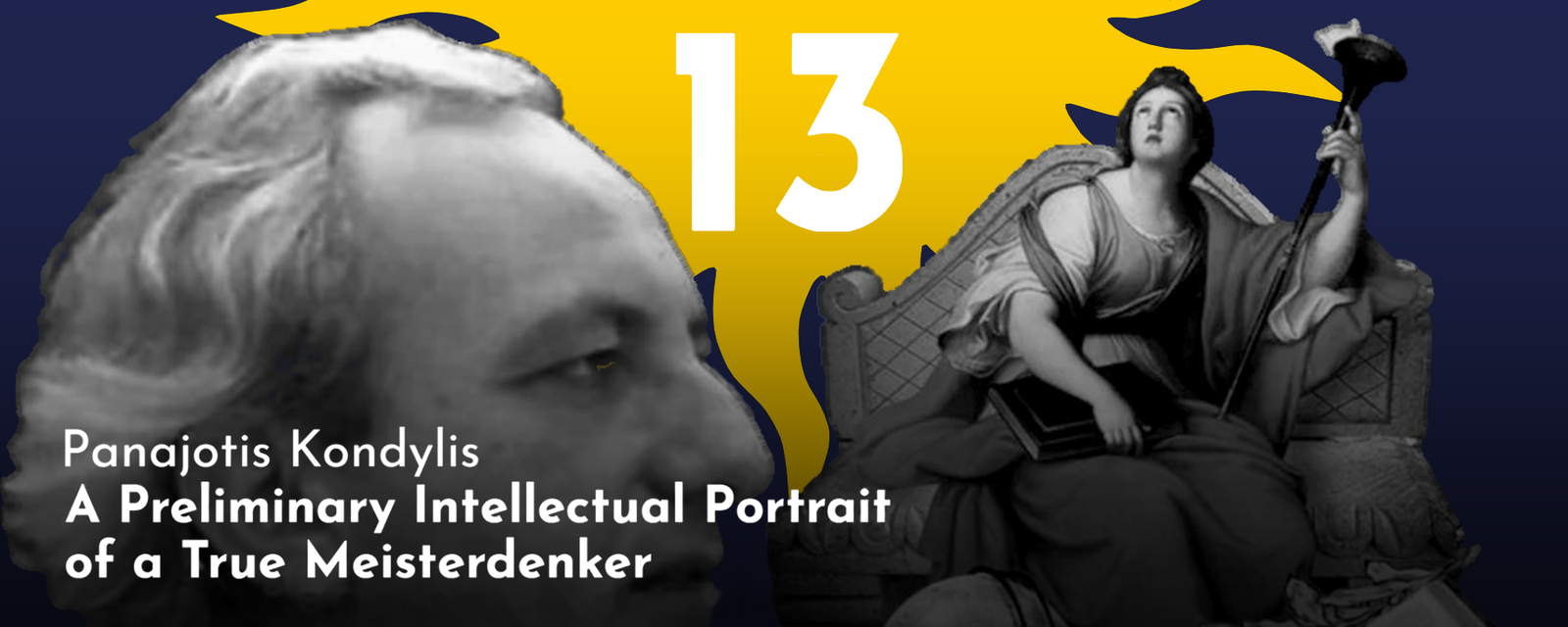
Panajotis Kondylis:
A Preliminary Intellectual Portrait of a True Meisterdenker
General preliminary remark:
Panajotis Kondylis (1943–1998) is probably, among all thinkers of the 20th century who did not achieve "meisterdenker status", the most significant and arguably the most erudite. Volker Gerhardt, professor of philosophy at Humboldt University in Berlin from 1992 to 2012, formulated the following assessment of Kondylis' work shortly after his death:
"With greater distance from the 20th century, one will discover that in Heidelberg there lived, as a private individual, a doctor of philosophy who continued the tradition of Max Weber more independently and productively than all the salaried professors of political science, sociology, and philosophy put together. This judgment stands despite the significant contributions to political theory made by Karl Jaspers, and it leaves the achievements of historians active in all the fields mentioned unaffected. The person I am referring to is Panajotis Kondylis, who in the 1970s earned his doctorate with a major, ambitious study on the Origin of Dialectics (1979), and then did not progress academically either in Heidelberg or in Athens. That was, one may say calmly, also a consequence of his wide-ranging intellectuality, which dealt with immense masses of material and masterfully crossed all disciplinary boundaries. Every one of his densely successive works would have done the faculties credit as a habilitation thesis."
Gerhardt's choice of Max Weber, whose knowledge inspired astonishment and reverence in more or less all of his contemporaries, regardless of their intellectual standing, as a measuring stick is entirely justified. The mastery of enormous quantities of material — no less than a theory of the European modern age worked through in detail from the standpoint of intellectual history was Kondylis' goal — has certainly enhanced his reputation among a small number of initiates, but unfortunately has also tended to hinder rather than promote broader impact, as Kondylis deliberately omits footnotes in some later works, disregarding the philosophical, general intellectual-historical, and political education that interested but non-doctoral readers might be expected to have. In line with the course of today's university, even today's doctors of the humanities are often capable of little more than perceiving Kondylis' writings as esoteric and hardly comprehensible. His book The Decline of the Bourgeois Form of Thought and Life, for instance, is highly demanding yet contains neither footnotes nor citations. Of course, the problem of the opacity of the educational prerequisites on which these books depend cannot be solved here, but what follows is an attempt to provide a condensed overview of the essential lines of Kondylis' thought across its various strands.
1. Life
Born in Olympia in 1943, Kondylis studied Classical Philology from 1963 to 1969. He then worked in Athens as a translator, publisher, and author. In 1971 he published his first monograph, simply titled Machiavelli, before beginning studies in philosophy, history, and political science in Heidelberg in 1972. In 1977 he earned his doctorate in philosophy with the approximately 700-page dissertation The Formation of Dialectics: An Analysis of the Intellectual Development of Hölderlin, Schelling, and Hegel up to 1802, supervised by Dieter Henrich. The dissertation was initially conceived as a 1,300-page work, which is why it later became two books: in 1979 the book on dialectics and in 1981 Enlightenment within the Framework of Modern Rationalism. From then on, Kondylis, as an independent scholar who preferred intellectual autonomy to integration into the university system, pursued an active career as author, translator, and editor. In the 1980s, a dense sequence of monographs appeared: Power and Decision (1984), Conservatism: Historical Substance and Decline (1986), and Theory of War: Clausewitz – Marx – Engels – Lenin (1988). The Critique of Modern Metaphysics (1990) and The Decline of the Bourgeois Form of Thought and Life (1991) brought this narrowly defined phase of Kondylis' intellectual-historical work to a close. These are to be understood as elements of a theory of the European modern age that was never systematically and fully elaborated. In 1991 he received the Goethe Medal of the City of Frankfurt am Main, and in 1994, supported by the Humboldt Foundation, he was a Fellow at the Wissenschaftskolleg in Berlin. In the 1990s, Kondylis increasingly turned to political questions, resulting in Planetary Politics after the Cold War and The Political in the 20th Century. His planned three-volume social ontology remained unfinished due to his early and unexpected death in 1998; only the first volume, The Political and Man, exists, in the form of a monumental fragment of around 650 pages. Kondylis' intellectual life's work also includes the founding of a 60-volume series, Philosophical and Political Library (Gnosis Verlag), and a 12-volume series, Modern European Culture (Nefeli Verlag), through which numerous classics — many of which Kondylis himself translated or introduced with prefaces — were made accessible to the Greek public.
2. Work
Kondylis' work can be broadly divided into three strands:
1. The intellectual-historical writings
2. The political writings
3. The social-ontological writings
(1) The intellectual-historical writings:
In The Formation of Dialectics, Kondylis traces the transformation of the dualism of spirit and sensibility, inherited from Friedrich Schiller as an authoritative problem, into a philosophy of unity first through Hölderlin and then through Schelling and Hegel. The central position in this transformation is occupied by Hölderlin’s development between 1795 and 1799, while Hegel’s influence on this transformation is assessed by Kondylis as “minimal,” since Hegel’s independent intellectual development only began after 1802. According to Kondylis, the intellectual-historical counterpart to the shift from a dualistic philosophy of opposition to a monistic philosophy of unity is the movement from the “dualistic structure of the Enlightenment” to the “monistic tendency of late German Enlightenment.” The speculative philosophy of unity, which goes beyond the systematic claims of modern philosophy and the “rehabilitation of sensibility” developed in the book on the Enlightenment, marks a specifically German break with the European Enlightenment and therefore requires a “reconstruction of the European Enlightenment,” which Kondylis presents in The Enlightenment within the Framework of Modern Rationalism, with special attention to the French and English elaboration of the relation between spirit and sensibility. Although these are two separate books, they in fact constitute only one approach artificially split into two volumes; hence — contrary to the visual impression created by their dates of publication — one must proceed from the book on the Enlightenment (1981) to the Dialectics book (1979).
In the Enlightenment book, Kondylis distinguishes between rationalism and intellectualism as fundamental worldviews that differ chiefly in the following respect: rationalism is a central element of the European Enlightenment, whose teleological intellectual endpoint Kondylis sees in the rehabilitation of sensibility, whereas intellectualism, which is often confused with rationalism, stands in the way of this rehabilitation of sensibility. “The Enlightenment in its main current, and not only Rousseau, turned not against rationalism but against intellectualism.” The philosophy of feeling and rationalism are not opposites; rather, the true antagonists are the philosophy of feeling and intellectualism, because only intellectualism can be regarded as the antipode of the “identification of nature and reason” (the human being is rational as a natural being and a natural being as a bearer of reason) and therefore resists “the incorporation of culture into nature.” Unlike rationalism, intellectualism, according to Kondylis, excludes the overcoming of oppositions, because it proceeds “from a dualistic assumption, insofar as it adopts the Cartesian separation of res cogitans and res extensa.” If it takes this up affirmatively, it sets both against each other in favor of res cogitans and enthrones intellect above feeling. If it takes it up only structurally, then, regardless of any sympathy for philosophy of feeling, there remains a gulf between the two, which intellectualism sanctions in principle. In both cases it opposes the rehabilitation of sensibility, which Kondylis identifies as the essential impulse of the European Enlightenment — and even of the German late Enlightenment, which, while moving systematically toward dualism, does not thereby renounce the struggle against nihilism carried out in the name of the rehabilitation of sensibility; in this respect, too, the German late Enlightenment is at least “an organic component of the pan-European one.” The rehabilitation of sensibility can be pursued by ratio in harmony with its own unfolding and in its own interest, because for Kondylis rationalism means the “purposeful, formally logically impeccable use of the argumentative means available to thought in support of a basic attitude.” According to this view, what stands opposed to ratio is not sensibility, but the logically irrational, because the latter undermines the immanent logic of ratio from within rather than merely relating to it in accordance with its logical modes of procedure.
“Since for us the criterion of the rational lies in the consistency of formal-logical thinking in the intellectual working-out of a basic attitude, the rational stands opposed not to the mystically irrational, but only to the logically irrational. In other words, the mystically irrational lies at a deeper level than the rational as well as the logically irrational, both of which stand on the same level and can therefore only contend with one another.”
With this, Kondylis clears the way for understanding the a-logical itself as the enabling ground of logical work and formation, and even for assigning logic a maieutic function in relation to the sensual: sensibility is then no irreconcilable opposite of the logical, but requires the logical in order to emerge, albeit transformed, through its formative power. Where the logically irrational is equated with the irrational, any logic that goes beyond testing inferences declares itself universally incompetent, because it cannot be the medium of what is not, by its very mode of procedure, an element of logic — which simply means: it cannot be a medium at all, because nothing can enter it and be processed by its formative power that is not grounded in its own modus operandi. Logic, thus identified with the rational, cannot attack sensibility, but can only fall silent before it, which is precisely the fate of the intellectually restricted intellect, which Kondylis assigns to Cartesianism in its various forms and against which “the Enlightenment as a whole stands under the sign of rejecting Cartesian basic positions”.
The overcoming of traditional theology, which is not revised by rationalism but rather domesticated and brought under direction by it, fundamentally depends on the intellectual utilization of rationalistic thinking instead of being outright hostile to rationalism as such. Rehabilitation does not consist in merely placing things side by side, but in unification, or at least reconciliation; modern philosophy, insofar as it is shaped by the extremes of intellectualism on the one hand, which asserts the primacy of the intellect within an axiologically conceived dichotomy, and nihilism or value nihilism on the other, which turns the “identification of nature and reason” against reason and at the same time attacks morality and theology as pillars of modern thought, is determined by a tension between opposing worldviews. The intellectualist line of modernity finds its decisive bearers and initiators in the emerging mathematical natural science of the 17th century and in Cartesianism, although Kondylis grants the former the greater influence over the latter:
“Descartes is regarded as the founder of modern philosophy, at least insofar as it is marked by the problem of self-consciousness and method. This assessment is largely correct, but it must be relativized by the observation that it is not the new philosophy, but mathematical natural science, that marks the true beginning of modernity.”
The intellectualist line of modernity prepares the emancipation from classical theology and metaphysics; by ordinary present-day understanding, it would therefore be Enlightenment-oriented at least in its impulse, but it does not belong to the Enlightenment itself because it stands in the way of the rehabilitation of sensibility by falling under suspicion of atheism. For it is precisely “the antagonism between intellectualism and empiricism, or between mathematical-geometrical and experimental method,” that sharpens within the epistemology of the Enlightenment. Kondylis emphasizes that empiricism must “be justified rational-argumentatively” (for, as we know, the rehabilitation of sensibility was a rational and not a sensual act). The “main empiricist current of the Enlightenment” stands, in the name of rationalism, in opposition to intellectualism, and in this the “logical ambiguity of rationalism” becomes manifest: one of its possibilities is intellectualism (for example in logical formalism, idealism, or moral rationalism), whereas its other possibility — not merely different from it, but polemically opposed to it — is the rationalism that seeks the rehabilitation of sensibility.
To avoid endless enumeration, only a few of the decisive stages discussed by Kondylis can be named here: the intellectual counter-movement against Cartesianism receives a decisive impulse from Newton and, above all, from Voltaire’s popularization of him. Helvétius and Condillac are just as influential in France as Locke and Hume are in England; as inaugurators of historicity in modern philosophy, Vico and Montesquieu are especially important. Leibniz’s importance can scarcely be overstated due to the scope of his attempt to reconcile the major intellectual currents of his age within a single systematic framework. What makes Leibniz an extraordinary case in intellectual history, according to Kondylis, is
“that the aspect of Leibniz’s thought which most strongly promoted the emerging philosophy of reconciliation structurally was already, at the very formation of this thought, in conflict with the aspect that could not satisfy the needs of the philosophy of reconciliation, or could not satisfy them to the same extent as the former, and was therefore set aside. What is meant here is, on the one hand, the separation of spirit and sensibility carried out at the price of the artificial construction of pre-established harmony, and on the other hand, the teleological unification of the two. This split within Leibniz’s philosophy, which appears in several forms (mathematics vs. metaphysics, mechanism vs. teleology, optimal static whole vs. the idea of development), can, just as in other cases we have encountered, be explained from Leibniz’s polemical intentions, that is, from the fact that he had two adversaries in view at the same time, so that the struggle against one required at least a partial withdrawal of the arguments used against the other.”
Beyond the logical details of Leibniz’s philosophy the groundbreaking effect of his philosophy of reconciliation lies in the transcendence of the opposition between intellectualism and rationalism, which in effect means that “the upgraded sensibility [is] endowed with the qualities of spirit or spiritualized, whereby the soul as a whole, with the additional help of the innate, was placed under the aegis of the moral in the broadest sense, that is, of the spiritual principle.” In this way Leibniz becomes the decisive stimulus for the German late Enlightenment, which in leading figures such as Lessing, Herder, and Hölderlin takes up the impulse toward reconciliation that continues to exert its influence even into German Idealism. Kondylis sees the reconciliation-oriented tendency of modernity break against Kant, whom he regards not as the face of the Enlightenment but rather as a major exponent of a “critique of the main current of Western Enlightenment,” one who carries out the fateful break with the “philosophy of reconciliation of the German late Enlightenment” by effecting a “union of intellectualist and skeptical positions that was radically novel.” Kant thus marks a rupture with the Enlightenment; the dualism he bequeathed kept Schiller in suspense throughout his life and then spread to the students of the Tübingen Stift (Hölderlin, Schelling, Hegel). Kondylis examines this intellectual-historical connection in his book The Emergence of Dialectics: An Analysis of the Intellectual Development of Hölderlin, Schelling, and Hegel up to 1802.
Also in the Dialectics book, the rehabilitation of sensibility is central; however, Kondylis approaches this systematically through Schiller’s adaptation of Kant’s separation of sensibility and rationality. It was precisely this Enlightenment impulse in the intensive engagement with Kant’s theory, which was not designed as a theory of reconciliation, that had a strong influence on Hölderlin. Kondylis draws equally on published writings — above all Hölderlin’s Hyperion, Hegel’s Frankfurt drafts, Schelling’s late Jena writings, and Hegel’s early Jena treatises — as well as letters, in order to combine the development of the works and the personal communication of the Tübingen Stift members in a comprehensive evidentiary study. Other influences besides Kant and Schiller — such as Rousseau, Hemsterhuis, Fichte, or Jacobi — are by no means ignored, but are treated as well.
The merit of Kondylis’ study lies, on the one hand, in showing in detail what immense weight Hölderlin had in the transformation of dualism into a philosophy of unification that is in character rather closer to monism, in the years 1795 to 1799; and, on the other hand, in having worked out the formative influence of Schelling’s writings from 1799 to 1802 on Hegel’s development of thought, which only came into its own after 1802. What Kondylis presents as a marked objection is the assumption that the development of dialectic was primarily Hegel’s achievement — an idea Kondylis calls the “Hegel legend.”
On the contrary: Kondylis grants Schiller a “quasi-ideal-typical relevance for the Tübingen thought of Hölderlin and Hegel,” deriving this from Schiller’s “sense of freedom” and his “strengthening of the position of science, whose domain is precisely sensibility on all levels.” On this basis, Schiller carries out a reevaluation within the Kantian dualism, but one that nevertheless stops at the rehabilitation of sensibility and is unable to advance to a philosophy of unification; this is also due to the fact that Schiller was not equal to the philosophical challenge embodied by Kant, “because he overlooks the fundamental significance of Kant’s doctrine of the two worlds and at the same time does not wish to take seriously Kant’s doctrine of radical evil, which has likewise acquired fundamental significance.” Fichte also builds on Kant and therefore represents a considerable challenge for the Tübingen Stift members, since “the Kantian Fichte does indeed feel compelled to take sensibility into account, but by no means rehabilitates it in the sense of Rousseau or Schiller”; instead, he advances a philosophy of the absolute I, through which Hölderlin sees himself forced to develop his philosophy “in polemic against Fichte.”
Hölderlin, however, does not lose himself in fruitless polemics that could end in a self-imprisonment within the old dualism, and his drafts and Hyperion are not merely theoretically inspiring poetic preliminaries, but the “first emergence of a consistent philosophy of unification.” Here three propositions can be cited that may be regarded as crystallizations of the difference between Hölderlin and Fichte: “If the coexistence of subject and object in consciousness presupposes their separation, then this separation likewise presupposes an original unity, that of being, not that of pure consciousness. From Fichte’s standpoint, this is of course sheer Spinozism.” And, breaking the supposed Spinozism through the philosophy of reflection: “If the I is not a substance, Hölderlin now thinks, then it can only be another expression for the inescapable reflexive structure of consciousness.” Kondylis traces the unfolding of this reflexive structure through the Hyperion fragments all the way to the completed novel in order to demonstrate, in this course of development, the narrative unfolding of a dialectical sequence of stages. In the strict sense, Hölderlin’s Hyperion is dialectical insofar as it literally realizes the “idea of the stepwise unfolding of spirit as the binding course of formation” in such a way that in the novel “each stage contains within itself the seeds of the higher one.”
A construction of this kind, according to Kondylis, can be found in Schelling’s philosophy-of-nature drafts from 1797–1798, from which point onward a dialectical concept of nature begins to emerge in his writings: “Only a nature that is at the same time conceived as subject and object can therefore satisfy the needs of dialectical construction; under the pressure of these needs, Schelling sees that construction as construction would be impossible if it did not proceed from the unity of subject and object at the highest level.” Schelling develops this construction in a systematically mature form in 1801 in his essay On the True Concept of the Philosophy of Nature, where he frees himself from the influence of Kant and Fichte insofar as he introduces a double concept of the subject-object: the subject-object of consciousness and the subject-object of nature. With the first concept, Schelling tries to work through the fundamental questions of transcendental idealism stemming from Kant and Fichte; with the second, he lets this theme rise into a Spinozism that nevertheless absorbs the idealist problematic rather than eliminating it. In Kondylis’ words: “Transcendental philosophy works with simple reflection, but Schelling wants to work with a double reflection that abolishes itself by demonstrating its own origin from the real.” Kondylis also paraphrases the real as the “unity of the positive and the negative within the absolutely positive.”
What gives Kondylis’ passage through Hölderlin’s and Schelling’s works its explosive significance cannot be fully extracted from those works themselves. Kondylis’ remarkable and highly deserving thesis is that Schelling developed these ideas not only independently of Hegel (indeed, in parallel with him), but before Hegel, so that Hegel began to develop his own dialectical conception only after both Hölderlin and Schelling had already produced fully formed versions of it. In this context, the following points made by Kondylis are especially important:
“Be that as it may, one must reckon with the fact that the ‘presentation’ was in print, or largely if not entirely printed, when Hegel began writing the ‘Difference’ essay; b) Schelling writes in the preliminary remark to the ‘Presentation’ that he had ‘lectured on this system last winter.’ The ‘Presentation’ therefore came into being before the winter semester of 1800–1801; in the lectures — if not even earlier — it had already attained its final and mature form.”
As long as this thesis has not been refuted — and so far it has not — one can speak of Kondylis having decisively disposed of the so-called “Hegel legend.” Strictly system-oriented philosophers might dismiss this as philological nitpicking mixed with biographical research and social history, but both the history of dialectic and the early history of German Idealism are decisively altered by Kondylis’ book, since the prevailing view is still that Hegel is unquestionably the true founder of a genuinely dialectical philosophy.
Of particular importance among Kondylis’ intellectual-historical works is Conservatism: Historical Substance and Decline (1986, new edition 2022). Kondylis understands conservatism as the “ideological and socio-political current” whose aim was the “preservation of the societas civilis and the ruling position of its upper strata.” Conservatism is thus defined as an ideology strictly bound to specific social carriers, owing its emergence to a politico-social constellation which, with roots reaching back into the Middle Ages, developed in modernity into its intellectually and historically distinctive form; Kondylis’ study extends to the Western European development (England, Germany, France). The law of this social form is understood as divinely given law until, with the emergence of the first theories of sovereignty in the 16th century, the conflict between divine-natural law and human-made law — and thus the “transition from the societas civilis to the dualism of state and society,” or, sociologically speaking, from aristocratic rule to the emancipation of the bourgeoisie from the nobility — is prepared, and is completed in the 19th century. Three decisive theses, which set Kondylis’ book apart from the conventional view, are linked to this:
1. Conservatism is an ideological phenomenon bound to historical constellations and carriers (above all the nobility), which as such has no anthropological significance and no longer has any concise meaning outside its proper historical constellation.
2. Edmund Burke is not the founder of conservatism, but its most influential younger representative, whose position is profoundly ambiguous, since he defends parliamentary sovereignty while at the same time rejecting the modern idea of sovereignty in its radical, i.e. secular, sense.
3. From the standpoint of intellectual history, conservatism is the protracted, multidimensional defensive struggle of the nobility against the bourgeoisie, which ideologically can be spelled out, among other things (for example in modern education), as a conflict between divine right and the modern idea of sovereignty.
Within this process, conservatism underwent several transformations: If the nobility initially constituted the conservative force in its struggle against the bourgeoisie, old liberals later became a conservative force in opposition to socialists. The transcendental counterpart of the conservative, the revolutionary, and with it the entire polemical constellation, has, according to Kondylis, been rendered obsolete within modern mass society (from around 1900), in which a “worker class not inclined toward revolution” no longer seeks any fundamental axiological transformation or reorientation of society. In the 20th century, Kondylis argues, the concept has dissolved into a gesture or into an emptied-out marker of recognition which, like the two complementary concepts of liberalism and socialism, came to be linked in rapid succession with so many shifting carriers that all three terms lost their original meaning in the 20th century and ossified into ritualistically invoked remnants of intellectual jargon
(2) The political writings
But Kondylis does not only work through the genesis, high point, and decline of classical conservatism; because of his early death, his intellectual-historical works could no longer be systematized into a theory of European modernity, which he believed had come to an end with the Cold War. While The Decline of the Bourgeois Form of Thought and Life (1991) offers a historical portrait of this form of thought and life, but also a physiognomic portrait of the hedonistic mass democracy that marked the Western bloc of the Cold War, Kondylis shows in Planetary Politics after the Cold War (1992) within which planetary constellation the hedonistic mass democracies had achieved victory and why, according to their internal logic, this victory could prove to be a Pyrrhic one. Kondylis unfolds an intricate dialectic of human-rights universalism as well as substantial reflections on a possible reversal of the economization of the political into a biologization of the political on the basis of this dialectic. The idea of an “end of history” is rejected not only implicitly in the book’s title, in which what comes after Planetary Politics is not envisioned as paradisiacal standstill but as a theoretical task; Fukuyama’s theorem is also dismissed by Kondylis as an ahistorical Western fantasy of self-glorification. The rise of China is already addressed in 1992, and Kondylis discusses the possibility that the internal structure of the Western, or hedonistic-mass-democratic, social model could, under changed conditions (for example, large refugee movements), turn against itself. He also considers the possibility that the United States could lose its preeminence because of internal conflicts; likewise, the relationship of Western Europe to Russia is discussed, and the idea of expanding NATO all the way to the Russian border is criticized as a geopolitically and diplomatically naive move that would needlessly burden the positive potential of German-Russian relations. Thus Kondylis was already saying in the 1990s: “European, especially German short-sightedness, as becomes visible for example in support for the American plan to expand NATO up to the border of Russia, risks fueling legitimate Russian mistrust and driving the Eurasian giant either into aggressive isolation or into China’s arms.” Regarding all this, see also.
(3) The social-ontological writings
A further strand in Kondylis’ work is his social ontology, as developed in Power and Decision (1984) and in his fragmentary work The Political and Man (1999). Central to his explicitly non-normative social ontology is the concept of decision, understood in a strictly value-free sense. Consequently, his decisionism is, expressis verbis, descriptive. The point is not to ground a normatively coded position in decision-theoretical terms, but to describe the genesis of normativity in terms of the logic of decision. Decision is viewed not merely as an event within the world, but as an act that constitutes and structures the world both for and through the deciding subject. The subject constitutes itself, its world, and thus its worldview through decisions, and it does so in a world in which it is constantly confronted with the sedimented decisions of others. Kondylis also treats the friend–enemy distinction explicitly in social-ontological terms rather than in the sense of what he calls “militant decisionism,” namely in normative-substantive terms; the value character of decision then arises from the fact that it has “sides” in the sense of binary yes/no values. Friend stands for the positive side of the decision, enemy for the negative reverse side. Because the subject constitutes itself and its worldview through the medium of decisions within a society, every decision serves self-preservation and embodies a claim to power. The social-theoretical complementary concept to decision is disciplining. Disciplining is a structure constituted by decisions that guides and coordinates decision-making behavior through socially mediated constraints and expectations, which are themselves manifestations of decisions. Through disciplining, an organized society comes into being; through it, individual and social worldviews are shaped in relation to one another; through it, norms are formed, and not only individual behaviour but also motivations for action and the specific forms taken by individual drives are moulded. It has primacy over morality; morality does not possess the power to determine social disciplining in the first instance.
Sebastian Edinger
Guest WriterPhilosopher