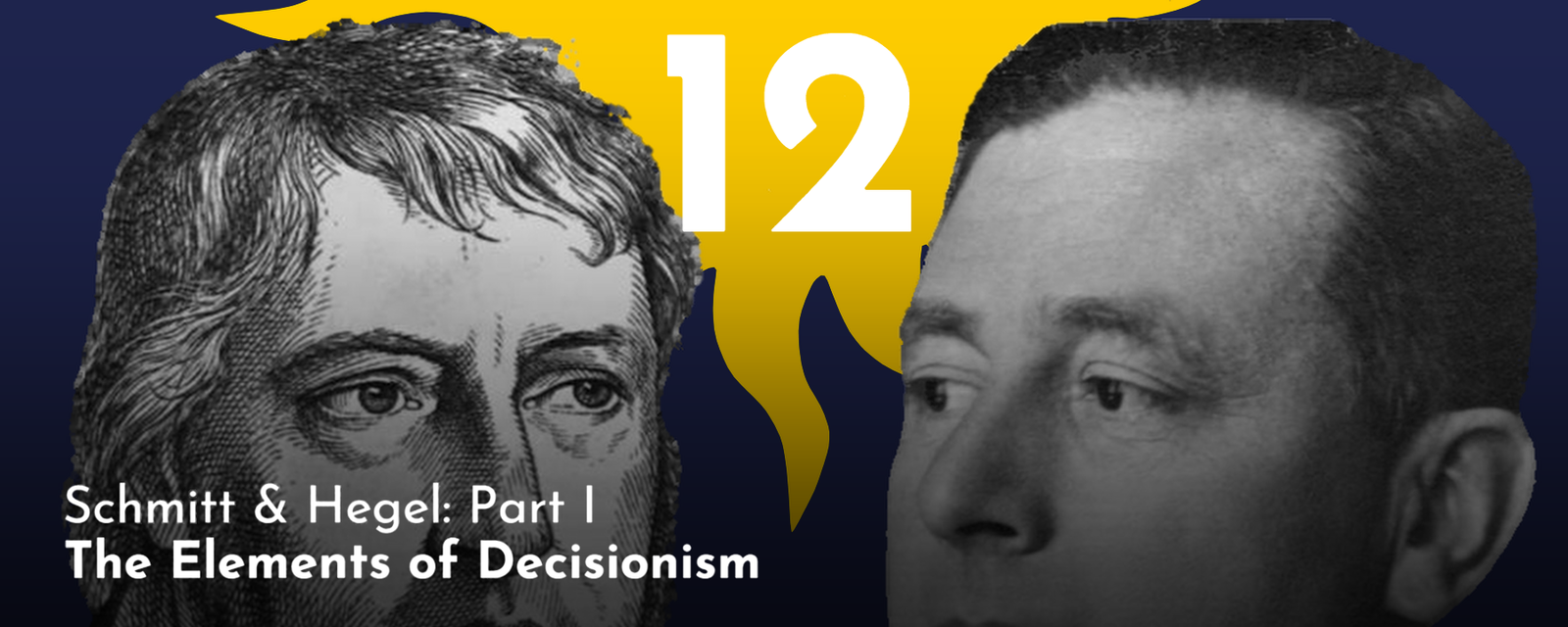
Schmitt and Hegel, Part I: The Elements of Decisionism
Introduction
This is the first article of a planned three-part series examining decisionism and enmity from both a Schmittian and Hegelian perspective. Despite their considerable differences, there are important conceptual and structural affinities between the thought of Schmitt and Hegel.
The purpose of this series is to illuminate these affinities and, in doing so, shed light on the deeper connection between the two.
As the title suggests, this first part examines the “elements” of decisionism in Schmitt’s thought. To summarise this part briefly: the decision is inseparable from an other, and consequently from the distinctions of association and dissociation through which identity becomes determinate. From this follows the historicity of the decision. Decisions are not made ex nihilo, but emerge from and intervene in historically constituted fields of relations. The historicity of the decision implies that the enemy – and, by extension, the political itself – is also fundamentally historical in character.
Part II will look at these questions explicitly through the lens of Hegelian logic, while also examining the Schmittian view developed here in light of Hegel’s thought. The aim of parts I and II is to demonstrate a structural continuity between Hegel and Schmitt, for whom concepts such as negation, determination, identity, difference, and dialectic hold central positions. Part III will then bring the two perspectives together by applying them to a concrete, historical, case study.
Schmitt: The Elements of Decisionism
Theodor Däubler, one of Carl Schmitt’s favourite poets, once wrote that “The enemy is our own question as form” (Schmitt 2017: 71). This brief statement has significant implications for intellectual history and, by extension, for social and political history. It suggests that a determinate I can emerge only in relation to a determinate You. The friend becomes intelligible through the enemy, because identity is constituted through distinction. Who we are depends, in part, on what we affirm and what we reject. The positive thus emerges through the negative. To affirm is to distinguish, to distinguish is to draw a boundary, and to draw a boundary is ultimately to decide.
Decisions are discriminatory acts in this fundamental sense because deciding presupposes a distinction between at least two possibilities – an either/or. What this further presupposes is a degree of indeterminacy – for, if the outcome was already fully determined, there would be nothing to decide. Within the indeterminate field of being, therefore, distinctions are not simply given; they become determinate through the possibility of choice. The decision transforms indeterminacy into determinacy. It bounds the unbounded, closes what was open, and gives form to an undifferentiated field of possibilities. In this sense, the decision is a constitutive act: it produces identities, establishes categories, and orders them within hierarchies of value. To decide, therefore, is not merely to select between pre-existing alternatives; it is to make those alternatives determinate as alternatives in the first place.
But the decision is not produced ex nihilo. The world upon which it acts is ultimately pregiven. Nature precedes human existence, just as history precedes the individual and provides the inherited conditions of society and culture. Nature and history are thus two dimensions of the world in which human life is situated, and both are indispensable to the formation of existential feeling. It is through the interaction between these pregiven conditions and the decisions through which they are interpreted and organised that existential bonds are formed or dissolved in relation to that which is and, simultaneously, through this relation, to that which ought to be.
It is within the pregiven sphere of society in particular that individual and collective identities take form. Society is the space in which the individual becomes actualised. It is where one comes to be what one is through, and in opposition to, the groups, ideas, practices, and distinctions that structure social life. Identity is therefore neither wholly imposed by the world nor freely chosen by the individual. Rather, it emerges through the encounter between inherited conditions and acts of differentiation, affirmation and rejection – in short, decisions. The individual finds himself already situated within a world of meanings and distinctions, yet it is through his relation to that world – through the boundaries he affirms, opposes, reproduces and wishes to displace – that he becomes determinate. The same applies to all social groupings.
For Schmitt (2007: 19), the concept of the state presupposes the concept of the political. What constitutes the political – and, by extension, the state – is the distinction between friend and enemy. This distinction does not follow the logic of morality, aesthetics, or economics. The friend is not necessarily morally good, aesthetically beautiful, or economically profitable, just as the enemy is not necessarily morally bad, aesthetically ugly, or economically unprofitable. For Schmitt, the enemy is, in the most fundamental sense, an existential other – an other whose existence, and whose very difference, is such that the possibility of physical violence and death becomes conceivable (Schmitt 2007: 26–27). Enmity therefore does not depend upon hatred, moral condemnation, or any particular substantive disagreement. What makes the enemy an enemy is the intensity of the relation of association and dissociation itself. A sufficiently high degree of dissociation transforms difference into an existential distinction, making conflict and physical violence possible. The political thus emerges where a distinction between us and them acquires an existential intensity sufficient to make organised conflict and violence possible.
In this sense, the friend-enemy distinction is merely a formal structure, insofar as it does not itself specify any substantive content, nor does it necessarily entail a particular institutional form. The friend-enemy distinction in the abstract tells us nothing about who the parties are, how many are involved in any given situation, or what constitutive form they take. But when the distinction moves from the abstract to the concrete world of social and political life it must acquire particular substantive characteristics. As Schmitt (2007: 38) observes:
“The political can derive its energy from the most varied human endeavours, from the religious, economic, moral, and other antitheses. It does not describe its own substance, but only the intensity of an association or dissociation of human beings whose motives can be religious, national (in the ethnic or cultural sense), economic, or of another kind and can effect at different times different coalitions and separations.”
The degree of association and dissociation between groups that produces existential tension is generated both within and between societies. The constituent elements of social life therefore possess the potential to acquire a political character in Schmitt’s sense. The very notion of a threshold at which private antagonism becomes public or political presupposes an underlying relational structure of association and dissociation whose intensity can increase. Beneath the political, therefore, lies a social substrate of association and dissociation from which the political emerges. Without this underlying social foundation, it would be unclear what precisely is being intensified – or, indeed, what a religious, moral, economic, or national antithesis is an antithesis of.
Society, in this sense, is not a “purely social,” “private,” or “apolitical” sphere in the liberal sense. It is the sphere in which antagonism and conflict, and, by extension, association and solidarity, arise prior to their incorporation into public or political organisation. The political therefore does not come into being ex nihilo; it emerges from social relations within and between societies whose intensity can cross a threshold and acquire an existential, political character. Political organisation consequently gives determinate form to antagonisms already latent within social life, transforming existing relations of association and dissociation into publicly recognisable political distinctions. The same applies to political unity. The unity of those who constitute themselves as “friends” precedes the constitutive act through which the state is established. The state does not create this unity ex nihilo; rather, its constitutive decision gives constitutional form to an already existing political unity, thereby determining the particular form of the state (Schmitt 2008: 75–77).
The state, then, is not the source of the political but its determinate institutional form. Whereas Max Weber (2019: 135–136) defines the state as a political, ruling organisation whose valid orders are legitimately enforced within a determinate territory through a monopoly on the legitimate use of coercive force, Schmitt goes further by focusing on the state’s capacity to decide. The state’s distinctive power lies not merely in enforcing an existing order, but in determining the conditions under which that order is to be maintained or transformed. In this sense, the state can be understood as possessing a monopoly on political decision. The state holds the authority to determine what is politically significant and how collective affairs are to be conducted in relation to the existential conflicts of a given historical situation.
Yet the state’s monopoly on political decision should not be confused with a monopoly on the existence of enmity itself. As was stated above, the capacity to decide cannot produce enmity ex nihilo. Rather, the state’s monopoly on decision concerns the public recognition and organisation of enmity. Externally, the state distinguishes friends and enemies among other states; internally, it determines which existing antagonisms within society acquire public standing and political significance. Enmity therefore both precedes the state and exceeds it once the state has come into being. The state does not create the possibility of enmity; rather, it gives particular forms of enmity public recognition, political significance, and institutional form.
Enmity therefore exists at both the private and public levels. States and other publicly recognised organisations have friends and enemies, but so too do private individuals and associations. Indeed, for the friend-enemy distinction to be logically consistent, it must encompass the broader field of human association and dissociation from which public enmity is differentiated. The distinction between private and public enmity would otherwise have no logical basis. There must first exist a field of social antagonism from which particular forms of enmity can be politically recognised, elevated to public significance, and organised. Political decision therefore selects, determines, and institutionalises particular antagonisms from among those already present within social and geopolitical life.
Enmity is complex for precisely this reason: it is layered. It is layered not only insofar as it exists simultaneously at the private and public levels, and internally and externally from the perspective of the state, but also insofar as it is fundamentally historical. If the world is pregiven through nature, and more importantly through history, then every decision necessarily presupposes a history of previous decisions and counter-decisions that has produced the constellation of forces and ideas in which it acts. No decision therefore confronts an entirely undetermined field of possibilities. A decision emerges from and intervenes in a world already structured by inherited distinctions, associations, antagonisms, and prior decisions. The historicity of the decision consequently implies the historicity of the enemy. Enemies are not simply identified within a static field of relations but emerge within historically constituted configurations of association and dissociation, which later decisions may reproduce, transform, or overturn. It is here that we can begin to see the dialectical movement underlying the historical logic of enmity in Schmitt’s thought. Decisions emerge from historically constituted antagonisms, yet, once they are made, they change – to varying degrees – the very constellation of relations within which coming antagonisms and decisions arise.
It should be quite clear by this point that decisions possess a functional quality alongside their existential significance for the groups or individuals that make them. Decisions must necessarily conform, at least to some degree, to an instrumental logic – one of efficiency, survival, and power – in relation to existing and potential enemies. Decisions serve existential needs by giving practical expression to rationalised hierarchies of value bound to particular identities or self-conceptions. In this sense, decisions reflect what a group or individual takes to be an “objective” or “meaningful” conception of reality – that is, an understanding of what is, what matters, and what must therefore be done in any given situation. Yet, owing to the dynamism of historical and social-political life, there is necessarily a multiplicity of such conceptions, corresponding to the multiplicity of groups with their own interests, identities, and rationalisations. Moreover, none of these groups is entirely static, since each must respond to changing historical circumstances and to the actions of others.
It is precisely in the necessity of adapting to changing historical, inimical, and polemical circumstances that the realities of power become apparent. For any social group, the existence of others with their own identities and conceptions of reality necessarily relativises its position and, with it, its power. The same applies to states, which, like social groups, exist within a hierarchy of power and political relevance determined by their standing vis-à-vis other states and social groups. What follows is a logic of self-preservation. Yet self-preservation cannot be conceived as static, given the dynamic character of historical existence. The preservation of a particular identity and form of life requires the capacity to maintain its boundaries against external powers, while changing circumstances may require those boundaries to be reinforced, defended, or extended. Self-preservation therefore contains a dialectical tendency towards expansion, precisely because the preservation of an existing position may itself require an increase in power.
For a group or state to sustain its historical existence, it must consequently defend the boundaries that constitute its identity against physical and intellectual attacks from its enemies. Under certain circumstances, the defence may require those boundaries to be extended through offensive action. This is because self-preservation, under historically dynamic conditions, depends upon the capacity to alter one’s position within a changing field or constellation of power. A group or state cannot simply reproduce itself unchanged through time. To preserve its identity, it must continually respond to – and, where necessary, seek to shape – the historical conditions in which that identity exists. In this sense, the preservation of existence contains within it a tendency towards the intensification of existence, which involves changes in the overall degree of association and dissociation across the social and geopolitical realms. How this process unfolds, however, is ultimately for the group or state itself to decide.
Lucas
FounderAve Europa Finland

Octavian
Main WriterAve Europa Germany