Friend and Enemy: Thoughts on Carl Schmitt's Central Contribution to Social and Political Thought
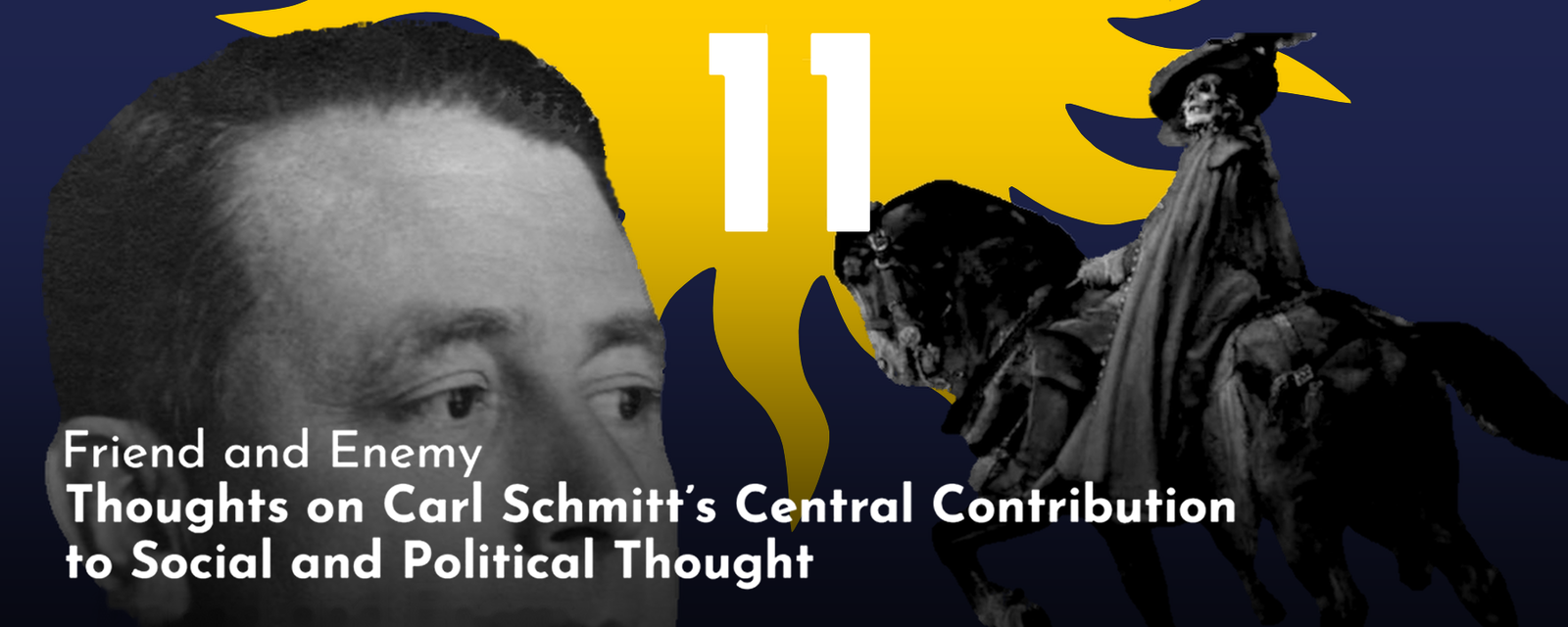
Carl Schmitt once remarked that all political ideas and theories can be judged according to their anthropological assumptions. He thought that political theories grounded in a pessimistic – or, “realistic” – conception of human nature, one that regards man as an animal always capable of violence, tend to be politically sound. By contrast, theories founded upon a melioristic view of man, according to which human beings are capable of being perfected and domesticated, ultimately give rise to utopian and, in the political sphere, dangerous doctrines.
If political ideas could be fundamentally distinguished according to their anthropological assumptions, then the political itself could likewise be distinguished according to its own defining criterion. Schmitt argued that just as morality is structured by the distinction between good and evil, and aesthetics by that between the beautiful and the ugly, the political likewise possesses its own fundamental distinction. For him, this was the distinction between friend and enemy: the highest degree of association and dissociation between human groups.
At this point, however, it is worth raising a more fundamental question. If Schmitt is correct that the friend-enemy distinction is central, does it belong properly to the political at all, or does it arise from the more fundamental reality of society? Modern society in particular is composed of multiple centres of force: a multiplicity of groups and individuals with differing interests, ambitions, and forms of association. These groups come into conflict, and these conflicts occasionally end in violence. If so, the friend-enemy distinction would appear to be a more general feature of social life than of politics itself.
Indeed, there are good reasons to regard the friend-enemy distinction as primarily social rather than political. First, the political is only one dimension of society. Politics emerges from social relations, while states and other political associations are themselves social formations. Second, the friend-enemy distinction must logically encompass both public and private forms of enmity. It therefore goes beyond the specifically public orientation of politics. For this reason, the friend-enemy distinction cannot serve as the defining criterion of the political, since it is a more general feature of social life than of politics itself. What actually distinguishes the political is organised public authority: the ordering of social and geopolitical relations according to normative ends articulated and enforced by those who govern.
Naturally, the question of what constitutes a good or bad, just or unjust, form of government depends upon one's normative commitments and, by extension, upon one's conception of human nature. If man is inherently wicked, then a strong government appears justified in the interest of the common good. But is this capacity for violence constant, as Schmitt implies? The entire tradition of philosophical anthropology has largely said no. Its main emphasis has been on the fact that man is a plastic being: a creature capable of being shaped by circumstance, culture, and history. The diversity of human societies, together with their continual transformation over time, bears witness to this fact.
But this plasticity is not confined to man alone. The institutions, practices, and ideas that human beings create are themselves plastic, capable of being redirected toward ends very different from those for which they were originally conceived. This is especially evident in the realm of ideas, whose meanings and functions are continually reinterpreted and reappropriated. If man is indeed malleable, then he is capable of both war and peace, of domination and cooperation. He is capable of both not because he lacks a nature altogether, but because his nature permits a wide range of historical and cultural actualisations. The crucial question, therefore, is what gives rise to the phenomena of conflict and war.
If conflict and war are not rooted in man – because man is by nature neither wicked nor good – then their origins must be sought outside of him. Conflict and war ultimately arise between men, between groups, and between societies. Human beings organise themselves into distinct, bounded groups, and the existence of a plurality of such groups – each with its own identity and interests – necessarily creates the possibility of conflict between them. This is an unavoidable feature of plurality itself. It is for this reason that Carl Schmitt referred to the world of politics – or, more accurately, the social world of friends and enemies – as a pluriverse.
One cannot have a group or a society without there also being an outside to it. Every society is itself a boundary, and within that boundary exists a multiplicity of further boundaries: families, institutions, unions, churches, associations, political parties, and the like. Conflict is thus a structural feature of social existence. War, as a political phenomenon, is ultimately governed by the same logic at the level of political communities. Conflict and war are therefore not diseases that can be cured, but structural features of social and political life. They cannot be eradicated, but that does not mean they cannot be regulated or moderated.
What follows from this is, first, that any conception of man which holds him to be internally wicked looks for a solution to social problems from the outside. This is abundantly clear in the case of Thomas Hobbes and, later, the reactionary thinkers of the French Revolution and its succeeding decades. Total problems ultimately require total solutions, and in this case the solution is the Leviathan, whether secular or theological. Second, thinkers such as Rousseau and Marx, who believed that man was internally good but corrupted by external conditions, naturally argued the converse of Hobbes. If evil originates in society rather than in man, then it is society that must be transformed. On the structural level, however, both pessimistic and optimistic anthropologies fail, for they employ the same fundamental logic in reverse. Neither fully comprehends the relationship between man and society and, by extension, the movement of history. One proposes artificial solutions; the other mistakes structural conditions for artificial problems. Ultimately, both remain utopian. Each seeks to transcend the constitutive conditions of social existence, even though it is precisely those conditions that give rise to the phenomena they seek to explain.
What follows from all this? Carl Schmitt was broadly correct in his anthropological insight: one's conception of human nature largely determines the form one's political prescriptions take in response to perceived problems. Yet this does not mean that one position must be optimistic and the other pessimistic. A supposedly pessimistic anthropology can, paradoxically, produce an optimistic politics, precisely because it presumes that there exists a cure – a katechon – for the human condition. Conversely, the optimist can become the greater pessimist, for if the source of conflict lies in the very structure of social life, then no political project can eliminate it. Human beings are social animals, and the plurality that characterises social existence continually reproduces the conditions of conflict. The optimist therefore finds himself confronting a problem that has no final resolution.
In this respect, Schmitt was once again partially correct. The friend-enemy distinction does indeed remain fundamental, but it belongs first and foremost to the social rather than to the political. Since politics is itself an expression of social life, it cannot abolish the conflicts that arise from social plurality; it can only order, regulate, and moderate them, and even then, without guarantee. Consequently, both the optimist's and the pessimist's hope for a final solution – a condition of absolute and permanent peace – must remain unattainable.
Lucas
FounderAve Europa Finland