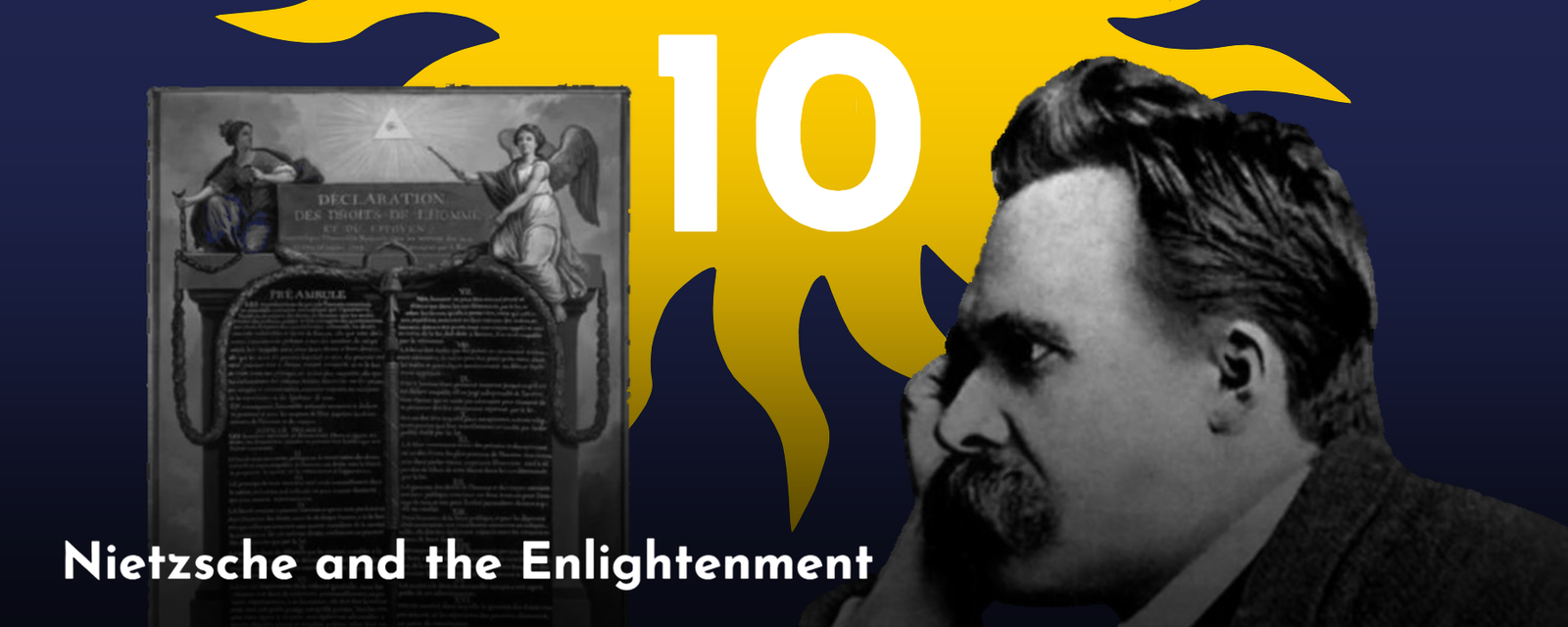
Nietzsche and the Enlightenment
Human, All Too Human is the work of a man who had just broken with a worldview he had held for many years. Having freed himself from the spell of Schopenhauer and Wagner, Nietzsche looked back to the Enlightenment. From it he drew particularly on the materialist-monist current within it – which he would develop into his mature philosophy.
Why, then, is Nietzsche so often regarded as an "anti-Enlightenment" thinker? The answer lies largely in a highly polemical conception of the Enlightenment, one that has instilled in us a certain "liberal-rational" picture of the epoch. But the Enlightenment is not reducible any more to "Reason" than the contemporary West is reducible to "Democracy," or Islam to "Jihad." What truly defined the Enlightenment was the rehabilitation of sense in the struggle against theology, scholasticism, and the Church. The human senses – touch, sight, smell – along with psychic and existential feeling, came to the fore as causes of human conduct and as the source of human thought.
What especially united the materialists of the Enlightenment was not a shared normative conclusion but a common descriptive premise: that nature is causal, mechanistic, and without any divine purpose. They differed, however, on whether that premise could sustain any normative claims at all. Diderot and Holbach sought to reconcile a fully naturalistic conception of the human being with an inherited ethics of sympathy, sociability, and enlightened self-interest, but neither fully explained why matter should give rise to such values. Only La Mettrie and Sade pursued the premise to its logical conclusion: if value is not inherent in nature, then nature authorises nothing. Virtue becomes, at best, a useful fiction and, at worst, indistinguishable from cruelty. Kant faced the same problem but took the opposite course by grounding normativity not in nature but in reason itself, and in doing so severed the moral law from the very causal order the materialists had sought to naturalise.
Nietzsche stands closer to the path opened by La Mettrie and Sade than to that of Diderot or Kant. Despite this, Nietzsche still ends up advancing ideals of nobility, rank, and the overcoming of ressentiment – a new normative framework, a new normative conception of nature, constructed only after the foundations of traditional morality had been dismantled. In this sense Nietzsche does not so much resolve the Enlightenment's internal division as embody it. His early works subject morality to a causal critique, while his later doctrine of revaluation marks the re-emergence of the normative on new terms. He is not, then, an observer standing outside this division and describing it; he is, in a way, one of the most complete expressions of the Enlightenment's dualism.
For this reason Panajotis Kondylis could say that one could reconstruct Nietzsche's thought almost entirely from Enlightenment materials. At the end of his book Die Aufklärung im Rahmen des neuzeitlichen Rationalismus, Kondylis leaves a remark on the Enlightenment and its legacy at the end of the twentieth century that is worth quoting in full:
"What consequences all this has had for a non-utilitarian or non-self-cancelling grounding of norms is by now sufficiently well known. At least in this sense, the Enlightenment – especially in the liberal West – is today more alive than ever. Yet it no longer appears in the form of the originally intended synthesis, but rather in its full inner division, namely as the incurable falling apart of the causal and the normative. The Enlightenment of the eighteenth century could usually forget or repress this division originally inherent in it because it was able to deploy both the causal and its normative elements against the theological opponent. Today, the old opponent is missing, and all that remains is the increasingly unpleasant awareness of the division. Some alleviate it by continuing to pursue conventional philosophical games, or even inventing new ones, such as those of linguistic analysis. Others dream longingly of a supposed pre-Enlightenment or pre-industrial idyll, and in passing discover – incidentally quite in the spirit of Enlightenment primitivism and exoticism – the deep wisdom of non-European customs. And the modest do not tire of insisting that they cannot recognise truth, from which – making a virtue of necessity – they derive the demand for tolerance and openness of society, as if such a demand could be binding even for those who do not regard themselves as ignorant. Contrary to these and similar positions and wishes, however, it is to be suspected that, as so often in history, those who will ultimately bring the crisis to an end – in their own way – will not be the nostalgic, nor the tolerant, nor particularly fine thinkers."
The division within the Enlightenment was expressed philosophically in Nietzsche. But Kondylis thinks the same division, once masked by a shared theological adversary, has since become unmasked as the structuring condition of the culture that succeeded the Enlightenment.
In 2026 it is perhaps quite clear that we are "further" from the Enlightenment than the Enlightenment was from the medieval world. But Kondylis is still correct that the Enlightenment is "alive," for its spectre still haunts us. Reinhart Koselleck identified the period between 1750 and 1850 as a Sattelzeit, a "saddle period" of rapid acceleration and change across all spheres of life and a corresponding shift in human experience and its horizons. Since 1850 there have been several Sattelzeits of this kind – perhaps 1890–1930, perhaps 1960–2020 – yet despite these successive upheavals in society and ideological thought, we remain largely embedded, both semantically and conceptually, within the world of the Enlightenment.
The Enlightenment's fight against feudal and religious prejudice was, of course, a prejudice in itself. The invocation of reason against "belief" and "authority" was carried out through belief in the authority of reason to dismiss whatever had come before it. The prejudices held by a society and its individual actors are precisely what is historical about it, for they carry the "spirit" of the culture they have inherited. Today we can see the consequences of a society that fights "prejudice" in all its forms in order to uphold a liquid relativity and a "pure humanity." Everything is stripped of its substance and replaced by its function, since any final synthesis would itself produce a hierarchy. There is no shared point of reference, but rather an empty, flat plain, upon which we are all supposed to coexist in any of the indefinite combinations of functions that can be imagined. This situation is becoming increasingly intolerable and untenable. The Enlightenment may be the source of this crisis, but perhaps it also holds the keys to its own undoing – and perhaps that key is Nietzschean in spirit. As Kondylis says at the end of his conclusion: "it is to be suspected that, as so often in history, those who will ultimately bring the crisis to an end – in their own way – will not be the nostalgic, nor the tolerant, nor particularly fine thinkers."
Whether "prejudice" or "anti-prejudice," each position represents a worldview, and each worldview lays claim to the meaning of life; and the meaning of life implies a will to power and self-preservation. Under the surface, power stirs, and each view relativises – and thereby threatens – the other by the mere fact of its existence in society. At some point the facade will end and something will have to be done, for the sake of life, no matter which form it takes or through what arguments or articles of faith it justifies its course of action.
Lucas
FounderAve Europa Finland